

AI Customer Service for E-commerce: How It Works and Why Stores Are Switching

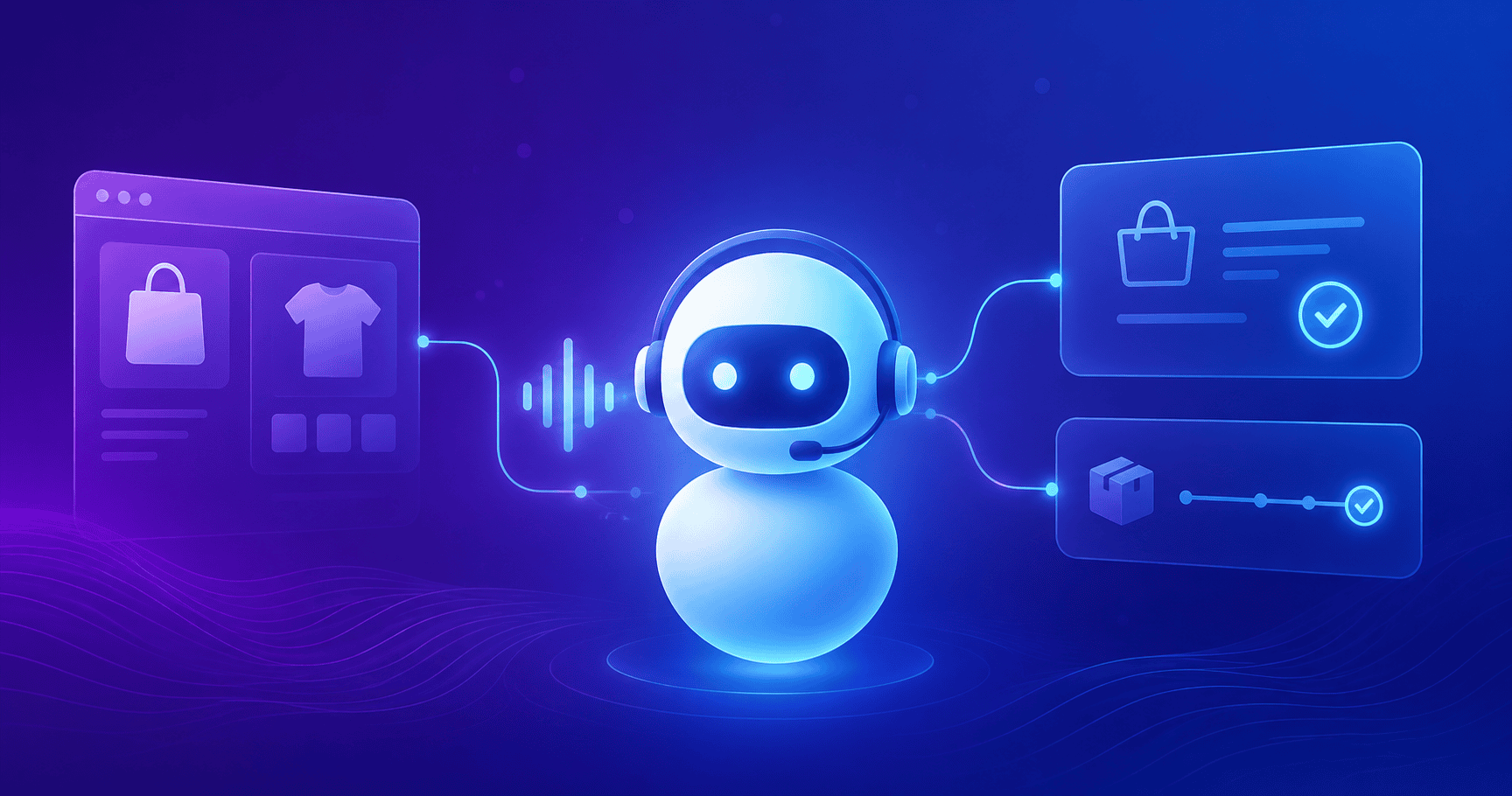
AI customer service for e-commerce is how a growing number of online stores are closing the gap between customer expectations and support capacity. Online shoppers expect answers fast. When a customer calls asking “where’s my order?” and gets put on hold or has to wait hours for an email reply, that friction costs sales and loyalty. This is why e-commerce brands are turning to automated systems that can answer calls, look up orders, and resolve common issues instantly, without a human agent on the line.
This post breaks down how AI customer service actually works for online stores, what tasks it can (and can’t) handle today, and why WooCommerce brands in particular are adopting it.
What Is AI Customer Service for E-commerce?
AI customer service refers to software — often a voice agent or chatbot — that handles customer support interactions using artificial intelligence instead of (or alongside) human agents. For e-commerce specifically, this usually means the AI is connected directly to the store’s live data: orders, inventory, shipping status, and refund policies.
Instead of a generic chatbot reading from a static FAQ, a well-built AI customer service system for e-commerce can:
- Look up a specific customer’s order status in real time
- Check current stock and product availability
- Process or initiate refunds within store policy
- Answer shipping and return questions using the store’s actual policies
- Escalate to a human when a request falls outside its scope
How It Works, Step by Step
- The customer reaches out — by phone call, chat widget, or another channel connected to the AI.
- The AI identifies the customer or order — usually via phone number, order number, or email lookup against the store’s database.
- The AI queries live store data — pulling real order, inventory, and shipping information rather than relying on pre-written scripts.
- The AI responds or takes action — answering the question directly, or executing an approved action like issuing a refund.
- The interaction is logged — a transcript or record is stored so the store owner can review what happened, spot patterns, or step in if needed.
The key difference between this and older-generation IVR (“press 1 for…”) systems or basic chatbots is that modern AI customer service tools are connected to live store data and can carry a natural conversation instead of forcing customers through rigid menus.
Why WooCommerce Stores Are Adopting AI Customer Service
WooCommerce powers a huge share of independent online stores, and most of them share the same problem: support volume grows faster than the team that handles it. This is exactly the gap AI customer service for e-commerce is designed to close. A few reasons AI adoption is accelerating specifically among WooCommerce merchants:
- Order-related questions are repetitive and time-sensitive. “Where’s my order,” “can I get a refund,” and “is this back in stock” make up the bulk of support volume — exactly the kind of structured, data-driven questions AI handles well.
- Off-hours coverage without off-hours staffing. A customer calling at 9pm still gets an answer, without paying for a night shift.
- Direct integration is now possible. Because WooCommerce exposes order, product, and customer data through its API, AI agents can plug directly into a store’s existing setup rather than requiring a rebuild.
- Cost pressure. Hiring and training a support team scales linearly with call volume; AI handling the repetitive tier of questions doesn’t.
What AI Customer Service Can’t Replace (Yet)
It’s worth being direct about limitations, both for credibility and because it sets accurate expectations:
- Emotionally sensitive complaints — an angry customer with a complex, non-standard complaint often still needs a human.
- Edge-case policy decisions — anything outside pre-approved rules (e.g., a refund past the policy window) should route to a person.
- Judgment calls — AI works best on clearly defined, rules-based tasks, not ambiguous exceptions.
The stores getting the most value from AI customer service aren’t replacing their whole team — they’re using AI to absorb the repetitive, high-volume tier of requests so human agents can focus on the cases that actually need a person.
Getting Started
If you’re running a WooCommerce store and evaluating AI customer service, start by looking at your support ticket or call log from the last 30 days and tagging what percentage are repetitive, data-lookup style questions (order status, refunds, stock checks) versus genuinely complex issues. That ratio is usually a good predictor of how much value AI support will deliver on day one.
Platforms like OrphoraAI are built specifically to deliver AI customer service for e-commerce: an AI voice agent that plugs into your WooCommerce store, answers calls with real order and inventory data, and hands off to a human when needed — without requiring you to rebuild your support workflow from scratch. See pricing plans to find the right fit for your store.
Want to see it in action? Try OrphoraAI live or get started for free →