
Deflect Support Calls: Outcome First Pilots for Contact Center Leaders
Contact center leaders: pilot outcome first call deflection with voice AI, wire WooCommerce order lookups, and measure confirmed resolution, re-contact,...


Call deflection means routing a customer away from a live agent toward self-service, whether that’s a knowledge base, a chatbot, or an AI voice agent. The right posture isn’t chasing a lower call count. It’s pairing every deflection tactic with confirmed resolution and re-contact tracking, so you know the customer’s problem actually went away. Order-status automation through voice AI, the approach Orphora AI builds for WooCommerce stores, is the clearest example of deflection done right.
TL;DR:
- High-volume, deterministic call types like order status and returns are the best initial targets for automation because they rely on existing data and have clear answers.
- Successful call deflection requires measuring resolution and re-contact rates to ensure customer issues are actually resolved and not just moved elsewhere.
- Voice AI for order lookup and returns can handle 50 to 70 percent of order-related calls with quick, sub-90-second interactions when fully integrated with backend systems.
- Automated flows must include clear success criteria, proper data transfer to agents, and conservative automation thresholds for complex issues to prevent failure.
- Pilot programs should start narrow, with around 20 percent traffic, strict thresholds, and thorough logging before scaling to ensure reliability and maintain customer trust.
Table of Contents
- What Is the Difference Between Call Deflection and Resolution?
- Which Call Types Should You Deflect First?
- Which Channel Fits Which Call Type?
- Where Call Deflection Programs Usually Fail
- What Should Your Call Deflection Scorecard Track?
- How Do You Pilot Voice AI Without Breaking Customer Trust?
- How Do You Get Agents to Buy Into Call Deflection?
- What Legal and Compliance Rules Apply to Call Deflection?
- Why Outcome-First Deflection Is the Right Call
- How Orphora AI Fits Into Your Deflection Strategy
- Sources
- FAQ
What Is the Difference Between Call Deflection and Resolution?
Deflection rate tells you how many calls never reached a human agent. Confirmed resolution rate tells you how many of those deflected customers actually got their problem solved without calling back. These are not the same number, and treating them as interchangeable is how contact centers end up celebrating a metric that’s quietly making customers angrier.
Here’s the trap: a customer asks a chatbot where their order is, gets a vague non-answer, gives up, and calls in three hours later anyway. That call registered as “deflected” the first time. It shows up in your dashboard as a win. But the customer experienced a dead end, not a resolution. Only a minority of issues get fully resolved through self-service without deliberate design, which is exactly why deflection rate alone misleads leadership into thinking automation is working better than it is.
Three metrics belong on every dashboard alongside deflection rate:
- Confirmed resolution rate: the share of deflected contacts where the customer’s actual issue was resolved, verified through follow-up data or explicit confirmation.
- Re-contact rate: how many deflected customers call, chat, or email again about the same issue within a set window (usually 24 to 72 hours).
- Escalation quality score: how cleanly a failed self-service attempt hands off to a human, including whether context and order data transferred with it.
Combining deflection with resolution, re-contact rate, CSAT, and escalation quality gives you an honest read on whether automation is actually reducing customer effort or just hiding it.
Which Call Types Should You Deflect First?
Not every call type deserves the same automation investment. Prioritize based on volume, predictability, and how cleanly the answer maps to data you already have.
- Order status (WISMO): these calls typically make up 25 to 40 percent of e-commerce support volume and the answer is almost always deterministic. If your order management system knows the answer, so should your automation. This is the obvious starting point for any pilot.
- Returns and exchanges: higher integration lift because you’re touching policy logic and possibly refund triggers, but the payoff is strong once wired up, since return status is another question with a data-backed answer.
- Billing questions: charges, subscription renewals, and invoice lookups are usually deterministic enough to automate with guardrails.
- Password resets and account changes: low risk, low complexity, and a reasonable second or third wave target.
- Subscription changes: pausing, upgrading, or canceling a plan, which benefits from automation once your policy rules are clearly codified.
Map your top 10 call intents by volume and by how deterministic the answer is, then build a control cohort. Route a percentage of WISMO calls to automation while holding back a comparable group for live agents, and compare resolution and satisfaction between the two before expanding.
Which Channel Fits Which Call Type?
Every deflection channel has a ceiling. Matching the channel to the intent, instead of defaulting to whatever’s cheapest to deploy, is what separates a pilot that scales from one that quietly generates complaints.
- IVR: cheap and familiar, but customers loathe menu trees for anything beyond routing. Good for triage, bad as a final answer.
- Knowledge base: strong for policy questions (“what’s your return window”) and weak for anything requiring live account data.
- Chatbots: handle scripted flows well but struggle with ambiguous phrasing and often dead-end into “contact us,” which just delays the call rather than deflecting it.
- SMS and proactive notifications: pre-empt calls entirely. Sending a shipping update before the customer thinks to ask can cut repeat WISMO contacts by 30 to 40 percent in some deployments.
- Community forums: useful for product how-to questions, nearly useless for account-specific issues like order status or billing.
- Voice AI: the only channel built for callers who want to talk, not type, and it can perform order lookups, initiate returns, and translate carrier tracking data into plain language on the fly.
Voice AI needs live integration with your order management system, carrier APIs, and returns platform to do any of that. Without that live data connection, an agent can’t confirm real-time delivery status and resolution rates drop fast. Mature setups with full integration have handled 50 to 70 percent of order-status volume with sub-90-second handle times.
Pro Tip: Don’t deploy voice AI and chat for the same intent simultaneously without a routing rule. Customers who bounce between channels for one question generate more re-contacts than either channel alone would.
Where Call Deflection Programs Usually Fail
Most deflection failures trace back to three patterns, and each one is fixable with a specific process change rather than a wholesale rebuild.
- Dead-end deflection: the self-service flow ends without an actual answer, and the customer has no clear next step. Fix it with a mandatory containment check: every automated flow needs a defined “success” state, not just an “end of script” state.
- Broken escalation: when automation fails, the human agent starts from zero because order details, chat history, and prior attempts never transferred. Pass transaction data, order number, and the full interaction log into the agent’s screen automatically, every time.
- Over-automating nuanced intents: billing disputes and complex returns involve judgment calls that a rules engine handles poorly. Set conservative automation thresholds for these intents and keep a human in the loop until confidence data justifies expanding scope.
A pilot-first approach with a control cohort is how you catch these failures before they scale. Watch for silent failure signals: rising re-contact rates on a specific intent, CSAT dips that don’t correlate with deflection rate drops, or a spike in agents flagging “customer already tried this online.” Any one of those three is a warning sign worth investigating within days, not at the next quarterly review.
According to industry cost analyses, deflection can cut certain support costs by as much as 40 percent, but that savings figure only holds up when it’s balanced against retention data. A cost win that quietly increases churn isn’t a win.
What Should Your Call Deflection Scorecard Track?
A useful scorecard blends operational metrics (how much volume you’re moving) with outcome metrics (whether that volume actually got resolved). Reporting only one side of that ledger is how leadership ends up surprised by a retention problem six months into a deflection push.
| Metric | What it measures | How to calculate it |
|---|---|---|
| Deflection rate | Share of contacts that never reached a live agent | Deflected contacts ÷ total contacts |
| Confirmed resolution rate | Share of deflected contacts where the issue was actually solved | Confirmed resolutions ÷ deflected contacts |
| Re-contact rate | Deflected customers who reach out again about the same issue | Repeat contacts within 72 hours ÷ deflected contacts |
| Escalation quality score | How cleanly failed automation hands off to a human agent | Rated on a defined rubric (context transferred, wait time, resolution on first escalation) |
| Cost per resolution | True cost accounting for both automation and any follow-up human handling | Total cost of channel ÷ confirmed resolutions |
If 1,000 calls get deflected and 820 never come back within 72 hours, your re-contact rate is about one-fifth, and your confirmed resolution rate (assuming those 820 also reported the issue as solved) is substantial. That’s the number that matters to your CFO and your customers alike. Review this scorecard regularly during a pilot and once a program is stable, with escalation quality scored by QA on a rolling sample rather than every ticket.
How Do You Pilot Voice AI Without Breaking Customer Trust?
A pilot succeeds or fails based on scope discipline, not ambition. Start narrow, measure honestly, and expand only when the data earns it.
- Pick one intent to start: order status is the standard first target because it’s high volume and fully deterministic once your voice AI has live OMS access.
- Set a conservative traffic split: route around 20 percent of eligible calls to automation and hold the rest with live agents as your control group.
- Define success thresholds before launch: for example, confirmed resolution rate above 85 percent and re-contact rate under 10 percent within a 72 hour window.
- Build the integration checklist: connect your order management system, carrier tracking APIs, and returns platform, plus a customer authentication step and full call logging for every automated interaction.
- Set governance rules up front: define which actions the AI can take autonomously (order lookup, tracking updates) versus which need policy guardrails or human sign off (refund approval, address changes), and keep an audit trail for every decision.
- Run QA on a rolling sample: score a percentage of automated calls weekly against your escalation quality rubric, not just at pilot’s end.
- Scale only after thresholds hold for two consecutive reporting cycles: one good week isn’t a pattern.
Voice AI flows should mirror the decision logic a trained agent would follow for deterministic intents like WISMO, while keeping firm policy boundaries around any action that writes to a customer’s account, like issuing a refund. Verifying identity too late, approving actions outside policy, and losing context during human handoff are the three failure patterns that sink most pilots, and all three are solvable with explicit rules rather than a full redesign.
Pro Tip: Log every automated decision, even the ones that succeed. When you eventually need to explain to a regulator or a frustrated customer why the AI took an action, the audit trail is what saves you.
How Do You Get Agents to Buy Into Call Deflection?
Agents often hear “we’re automating this call type” as “we’re automating your job,” and that fear shapes how they behave during rollout, sometimes in ways that sabotage the pilot without anyone intending it. The fix starts with reframing the goal honestly: deflection is meant to remove repetitive, low-judgment calls so agents spend more time on disputes, retention saves, and the conversations that actually need a person.
Bring frontline agents into the pilot design instead of announcing it after the fact. They already know which WISMO calls are truly simple and which ones hide a complaint about a damaged package or a missed delivery window. That knowledge should shape your escalation rules, not get discovered the hard way after launch.
Train agents specifically on the handoff moments: what a failed automation attempt looks like on their screen, what context should already be there, and how to acknowledge a frustrated customer who just spent five minutes fighting a bot. That training matters more than any script update, because a customer who escalates after a failed self-service attempt is already primed to be annoyed.
Track adoption with the same rigor you track customer metrics. If agents are manually overriding automated routing more than expected, that’s a signal the automation isn’t ready for that intent, not a compliance problem to punish. Give supervisors a clear channel to flag friction weekly during the pilot phase, and treat that feedback as data, not noise.
What Legal and Compliance Rules Apply to Call Deflection?
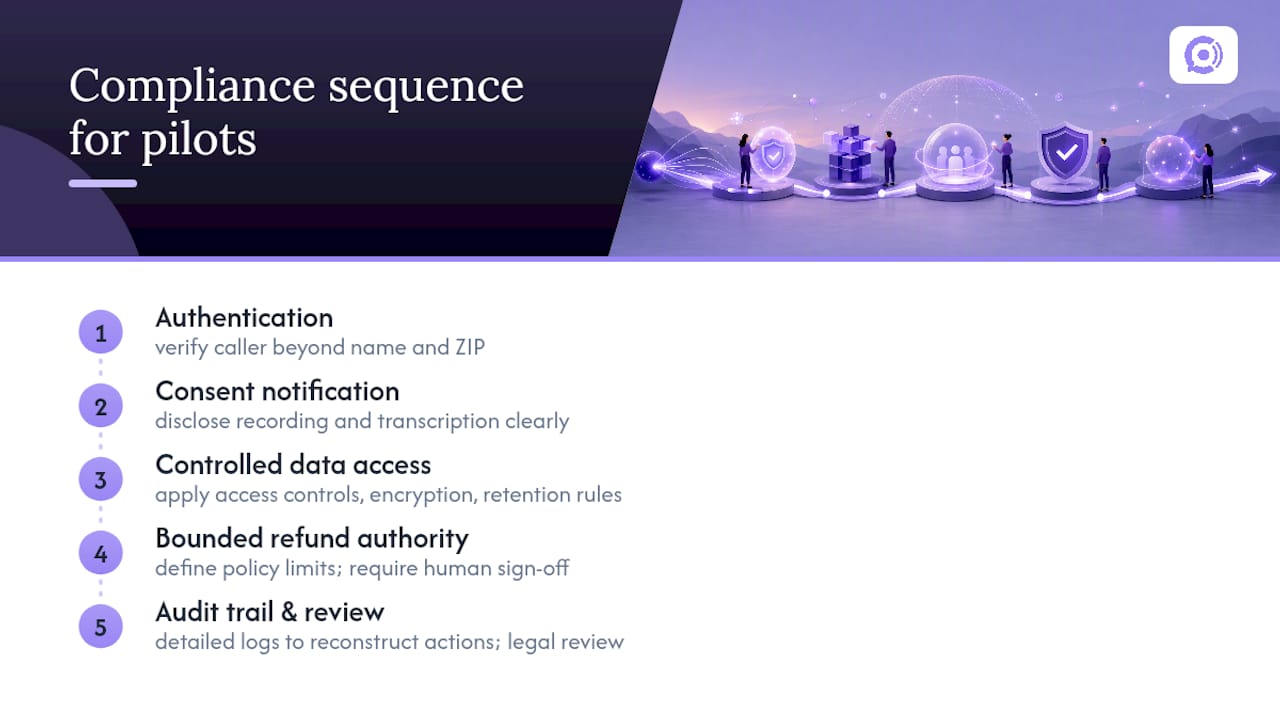
Any system that touches customer identity, payment data, or account changes carries compliance weight that a simple FAQ page doesn’t. Authentication is the first checkpoint: before a voice AI agent discusses order details or processes a return, it needs to verify the caller is authorized on that account, using something more reliable than a name and zip code alone.
Recording and transcribing calls, standard practice for AI voice agents and for quality assurance generally, requires disclosure to the caller in most US jurisdictions, and rules vary by state on whether one-party or two-party consent applies. Build a clear notification into the call flow rather than treating it as a legal afterthought bolted on later.
Data handling matters just as much. Order history, payment details, and personal information moving through an integrated voice AI system need the same access controls and encryption standards you’d apply to any customer data pipeline, and your retention policy for call recordings and transcripts should match your broader data governance rules, not run on a separate, looser standard.
Refund and return actions taken autonomously by AI need clear policy boundaries and an audit trail, both to protect the customer from an incorrect automated decision and to protect the business if a dispute arises later. Any system granted the authority to approve a refund needs logging detailed enough to reconstruct exactly what happened and why, and legal counsel should sign off on where the automation’s authority ends and human review begins before a pilot goes live, not after a disputed case surfaces.
Why Outcome-First Deflection Is the Right Call
Most contact centers still report deflection rate as if it were the finish line. It’s the starting line. A support system that removes calls from the queue without confirming the customer’s problem got solved is just moving frustration somewhere quieter, and it eventually comes back as churn.
Orphora AI built its voice agents around that principle, with claims of 85% faster response times and 95% satisfaction on WooCommerce order and return inquiries handled without human intervention. Case studies from early pilots are still being compiled for publication. The strategic bet is simple: automate the deterministic questions completely, and measure the results honestly enough to prove it.
— Orphora AI
How Orphora AI Fits Into Your Deflection Strategy
If you’re running a WooCommerce store and evaluating where to start, order status and returns are the two intents with the clearest data trail and the fastest path to a measurable pilot. Voice agents can connect directly to your store data to answer order lookup and returns questions around the clock, with no queue and no hold music.

The features that matter for a real pilot are the ones tied to those two intents specifically: live order lookup pulled straight from WooCommerce, returns initiation without a human touching the ticket first, and call logging that gives you the audit trail compliance teams ask for. Coverage runs 24/7, which matters most for the after-hours WISMO calls that otherwise pile up overnight and hit your queue first thing in the morning.
A voice-AI pilot makes sense when you already have a high-volume deterministic intent like order status; incremental self-service work (better FAQ pages, smarter chat scripts) makes more sense when your call types are varied and judgment-heavy. If your WISMO volume looks anything like the 25 to 40 percent industry norm, that’s the signal to start testing. Check the feature breakdown to see how the integration works, or review the installation guide to scope what a pilot would take on your store.
Sources
- Why call deflection is no longer the contact center’s north star — TechTarget — 2026-08-18
- Voice AI agents for e-commerce & retail: 2026 guide — Raftlabs
- How to Use Voice AI for Ecommerce Customer Service — Agxntsix
FAQ
Is Call Deflection the Same Thing as Ignoring Customers?
No. Done well, deflection routes customers to a faster answer than waiting on hold, but it only works when paired with confirmed resolution tracking so failed attempts still reach a live agent quickly.
What Should You Say When a Self-Service Flow Fails to Answer the Question?
The flow should hand off to a human agent with full context already attached, including order details and what the customer already tried, rather than making them repeat everything from scratch.
Which Call Types Are Riskiest to Automate?
Billing disputes and complex return exceptions carry the most judgment calls and the highest risk of a wrong automated decision, so most teams keep conservative thresholds and human review on those intents longer than on order status.
Is Deflection a Form of Emotional Manipulation Toward Customers?
Not inherently. Deflection becomes a problem only when it’s designed to prevent contact rather than to resolve it faster, which is why re-contact rate and confirmed resolution rate matter as much as the deflection number itself.
How Quickly Can a Voice AI Pilot Show Results?
With a conservative traffic split and daily monitoring of resolution and re-contact rates, most teams see enough signal within two to four weeks to decide whether to expand the pilot.