

Small Businesses: 30 Day Test to Decide Toll Free or Local
For small businesses: a five-question checklist, port safe provisioning, and a 30–90 day test to compare toll free and local numbers.


If your customers are scattered across the country, get a toll-free number. If you’re a plumber, dentist, or shop that lives and dies by one zip code, a local number builds more trust for less money. Most growing small businesses eventually run both and let the data decide which one better supports your business.
TL;DR:
- Local numbers build trust when your business operates mainly within one region, but they can be less effective if your customer base expands nationally.
- Toll-free numbers signal a nationwide presence, removing customer hesitation and often cost less per month if call volume is low.
- Switching between local and toll-free numbers involves carrier-specific porting processes and must be carefully managed to prevent call disruptions.
- Toll-free numbers incur per-minute charges paid by the business, which can escalate quickly with high call volume, making sizing important.
- Combining both numbers and using automation solutions ensures consistent customer experience and cost-effective operations at scale.
Table of Contents
- Toll-Free vs Local: What Local Numbers Actually Are
- Advantages of Local Numbers for Small Businesses
- Where Local Numbers Fall Short
- What a Toll-Free Number Is and How It’s Routed
- When Toll-Free Numbers Pull Ahead
- The Costs and Constraints of Going Toll-Free
- A Compact Checklist for Choosing (Or Combining) Both
- How to Provision and Port a Number Without Losing Calls
- The Practical Mixed Setup Most Small Businesses Land On
- How Automated Voice Agents Close the Gap Between Both Number Types
- Quick Next Steps if You’re Still Undecided
- A Simpler Way to Handle Both Numbers at Once
- Sources
- FAQ
Toll-Free vs Local: What Local Numbers Actually Are
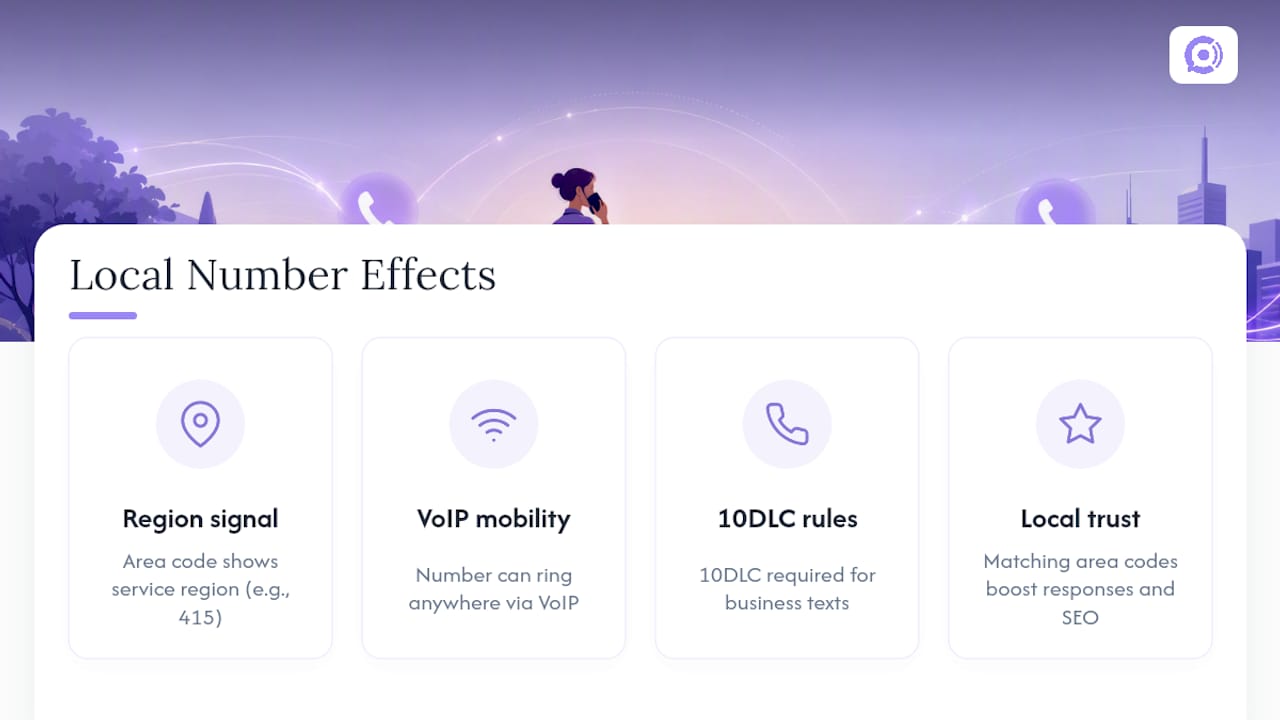
A local number carries the area code of a specific region, like 415 for San Francisco or 212 for Manhattan. That prefix instantly tells a caller, without a word being spoken, where you’re supposed to be.
Most small businesses today run local numbers over VoIP rather than a physical copper line, which means the “local” number can technically live anywhere and still ring a cell phone in another state. That flexibility is common but worth knowing, because it changes how customers interpret the area code. If you’re sending marketing texts, 10DLC registration rules apply to local numbers used for business texting, and carriers throttle unregistered traffic.
The trust effect is real and measurable in behavior, if not always in a published statistic: people searching “plumber near me” respond differently to a number that matches their own area code than to an 800 number. Search engines and directory listings also tend to favor address and phone consistency tied to a real service area.
Advantages of Local Numbers for Small Businesses
A local number does its best work when your business is tied to a place. Here’s where it pulls ahead:
- Territorial trust. A matching area code signals you’re a neighborhood business, not a national call center, which matters for home services, medical practices, and local retail.
- Search and ad relevance. Local numbers align with Google Business Profile listings and local search results, and they make phone-based attribution in local ad campaigns cleaner to track.
- Lower routine costs. Most local VoIP lines run cheaper per month than a toll-free line once you factor in per-minute charges, especially if your call volume is modest.
- Simpler continuity. If you’re staying within the same regional carrier ecosystem, porting a local number when you switch providers tends to involve fewer moving parts than international or cross-network toll-free transfers.
Where Local Numbers Fall Short
A local number has a ceiling. Once your customer base spreads past one region, that same area code that built trust locally starts working against you: a customer in Ohio calling a number with a Texas prefix may assume you don’t serve their area at all, even if you ship nationwide.
There’s also a security wrinkle worth knowing. Caller ID can be faked, and scammers routinely spoof local-looking numbers specifically because people trust them more. A matching area code on your caller ID does not, by itself, prove legitimacy to a wary customer, and it doesn’t protect your business from being impersonated by a scammer using a similar prefix.
Practical friction points to plan around:
- Moving your business outside the original area code can complicate keeping the number, and some porting requests hit carrier-specific rules or delays.
- A local number gives callers zero signal that you can help them if they’re outside your metro area, which can suppress inbound calls from regional or national campaigns.
- Rural carriers sometimes carry porting waivers or restrictions that catch business owners off guard mid-move.
What a Toll-Free Number Is and How It’s Routed
Toll-free numbers use a defined set of prefixes: 800, 888, 877, 866, 855, 844, and 833. On these calls, the business being called generally pays the cost, not the person dialing in, which is the entire point of the format.
That cost model shapes caller behavior in a subtle way: it removes hesitation. A customer weighing whether a call is worth their minutes doesn’t have that friction with a toll-free number, which matters more than people assume for support lines and order hotlines.
Ownership and portability run through a system called RespOrg (Responsible Organization), the entity authorized to manage a toll-free number’s routing on your behalf. Switching providers means transferring RespOrg status, and Somos administers the underlying TFNRegistry that tracks number ownership and status across the industry. This is different plumbing than a standard local port, and it’s worth understanding before you commit a marketing budget to a specific 800 number.
When Toll-Free Numbers Pull Ahead
A toll-free number does one job better than anything else: it tells the whole country you’re open for business, regardless of where “business” physically happens.
- National credibility. An 800 number reads as established and serious, particularly for e-commerce, financial services, and B2B companies without a single home base.
- Removes the cost objection. Since the business absorbs the call charge, customers dial in more freely, especially for support or complaint calls where hesitation otherwise kills the interaction.
- Centralized support at scale. One number, one routing system, no confusion about which regional line to call, which simplifies training and reporting for a growing support team.
- Vanity branding. Numbers like 1-800-FLOWERS turn a phone number into a marketing asset that people remember without writing it down.
The Costs and Constraints of Going Toll-Free
Toll-free isn’t free, obviously, and the naming convention trips people up constantly. Someone calls it “toll-free” and assumes it’s free to operate, when really the business is footing a per-minute bill for every incoming call. Budget for volume, not just for the number itself, because a support line that suddenly gets popular can rack up a bill nobody planned for.
Vanity number availability is also tighter than most owners expect. A memorable combination on 800 might already be taken while the identical digits sit open on 888, because prefixes function as separate, non-interchangeable routing identities. You can’t assume a number exists just because a similar one does.
Administrative overhead is the third friction point:
- Changing toll-free providers requires a formal RespOrg transfer, not a simple port request, and typically involves a Letter of Agency confirming you own the rights to make the change.
- Not every prefix or vanity combination is available, and reserving one before a campaign launch is worth the extra step.
- Somos’s ROC Help Desk process handles disputes and ownership verification, which matters if a number’s status gets flagged mid-transfer.
A Compact Checklist for Choosing (Or Combining) Both
Run through these five questions before you commit a marketing budget to one number type:
- Where do your customers actually live? If your service area is one metro or region, lean local. If your customer base spans states or you sell online nationally, lean toll-free.
- Does removing the caller’s cost matter? Support and complaint lines benefit more from toll-free than a simple appointment-booking line does.
- What’s the campaign type? Transactional confirmations and local scheduling calls do fine on a local line; national marketing pushes and support hotlines do better toll-free.
- What’s the projected call volume? Estimate minutes before picking toll-free, since the business pays per minute on every inbound call.
- Are your outbound workflows compliant? The FTC’s Do Not Call Registry carries over 258 million active registrations, and any outbound calling program needs suppression lists and documented consent before dialing, regardless of which number type places the call.
Pro Tip: Don’t guess. Provision both a toll-free and a local number for a 30-day test campaign, route them to the same team, and compare answer rates before you standardize on one.
How to Provision and Port a Number Without Losing Calls
Migrating a business phone number wrong means missed calls during the exact window customers are trying to reach you. Follow this order:
- Check availability first. For toll-free vanity numbers, confirm the exact digits are open on your chosen prefix before you print it anywhere.
- Activate the new service before canceling the old one. FCC porting guidance recommends starting the new provider’s service first and keeping the old line active until the port fully completes, since simple ports usually finish within one business day but complex moves can take longer.
- Build out routing and the caller experience. Set up your IVR or auto-attendant, voicemail-to-SMS forwarding, and a unified inbox so no channel gets missed during the transition. A tool like ready-made IVR scripts and voice-over production can shortcut this step if you don’t want to record prompts yourself.
- Track and verify. Set up call tracking so you can compare performance across old and new numbers, and confirm your caller ID displays correctly on outbound calls before going live.
The Practical Mixed Setup Most Small Businesses Land On
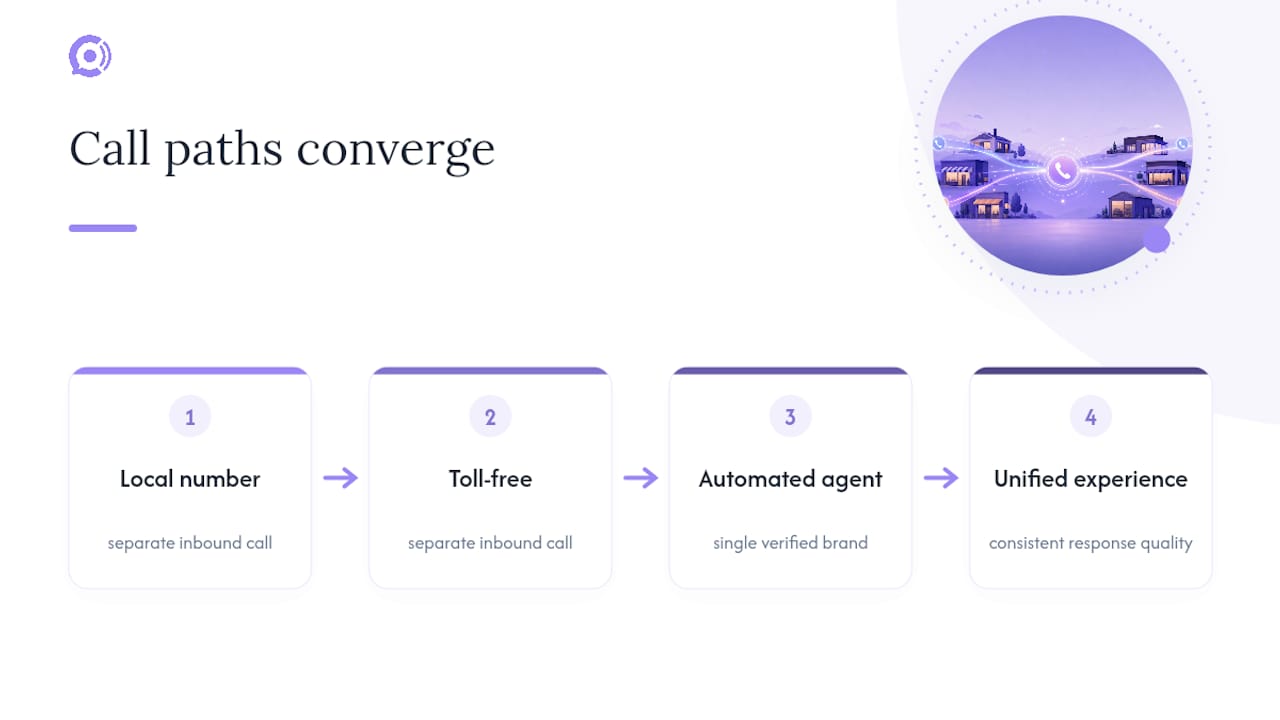
Run a toll-free number as your primary support and marketing line, then layer in local numbers for region-specific campaigns or offices. Route everything into one trained team or one automated system so customers never sense a difference in service quality based on which number they dialed.
Measure four things, separately, by number:
- Answer rate (are calls actually being picked up, or going to voicemail)
- Qualified call volume (is the traffic actually sales or support relevant)
- Conversion rate (does the call turn into a sale, booking, or resolved issue)
- Cost per resolved interaction (total number cost divided by successfully handled calls)
Run a short A/B test, by number or by campaign, before locking in a permanent setup. Four weeks of real data beats any assumption about which number “should” perform better.
How Automated Voice Agents Close the Gap Between Both Number Types
One operational headache with running toll-free and local numbers side by side is keeping the caller experience consistent no matter which one someone dials. An automated voice agent solves that by presenting one verified brand identity and one quality of response, regardless of the inbound number.
Quick Next Steps if You’re Still Undecided
Test both if you’re genuinely torn. Run a 30 to 90 day window, track answer rate and conversion separately by number, and let the data settle the argument instead of a hunch. Whatever you pick, protect number continuity during any provider switch and lock down your outbound compliance workflow before the volume scales past what you can manage by hand.
— Orphora AI
A Simpler Way to Handle Both Numbers at Once
Running a toll-free line and a local line well means someone, or something, has to answer both consistently, 24/7, without dropping order details or making customers repeat themselves. That’s the exact gap Orphora AI closes for WooCommerce stores.

Instead of hiring extra staff to cover a growing support queue across multiple numbers, Orphora AI’s voice agents plug directly into your WooCommerce order data and answer common questions like order status and returns instantly, day or night, no matter which number the customer dialed. This fits stores that already run both a toll-free support line and local numbers for regional campaigns and want one consistent, order-aware voice behind all of them. Pricing starts at $9.99 per month per agent plus $0.10 per conversation minute, with no need to staff a call center to cover the hours your customers actually call. Check the feature breakdown to see how the WooCommerce integration works, then request a demo to see it handle a real order lookup before you commit.
Sources
- What Is a Toll-Free Number and How Does it Work? | Federal Communications Commission
- Porting: Keeping Your Phone Number When You Change Providers | Federal Communications Commission
- FTC press release on National Do Not Call Registry data and compliance
- Scammers can fake caller ID information | Federal Trade Commission
- TFNRegistry UI: What are the Number Admin Statuses and their Definitions? – Somos
FAQ
Is It Better to Call Toll-Free or Local?
Neither is universally better. It depends on whether the business you’re calling operates regionally (local number fits) or nationally (toll-free fits), and both cost the caller nothing extra to dial in most cases.
Does Toll-Free Still Matter?
Yes. Toll-free numbers still signal national reach and remove cost hesitation for callers, which is why businesses continue relying on the FCC-defined prefixes (800, 888, 877, 866, 855, 844, and 833) for support and marketing lines.
Who Pays for a Toll-Free Call?
The business that owns the toll-free number pays for the incoming call, not the person dialing. That’s the defining feature of the toll-free cost model the FCC describes.
Will I Be Charged for Calling a Toll-Free Number?
No, calling a toll-free number from a standard phone doesn’t cost the caller anything beyond their normal plan minutes, since the receiving business absorbs the charge. Mobile plans with unlimited minutes make this largely a non-issue either way.
Can Orphora AI Handle Calls From Both Number Types?
Orphora AI’s voice agents answer inbound calls and route WooCommerce order and return questions automatically, regardless of whether the call comes through a toll-free or local line. Pricing runs $9.99 per month per agent plus $0.10 per conversation minute.