

Stop Repeat Explanations: Ecommerce CX Rules for AI to Human Escalation
Practical escalation rules for CX and platform teams: warm AI to human transfers, SLAs, and audit logs, with a WooCommerce voice example.


Escalate whenever a deterministic trigger fires, a low confidence score, an explicit user request, or a high-stakes action, and always perform a warm transfer that carries a concise summary, a confidence score, and identifiers. The handoff only counts as successful when the receiving human can act without asking the customer to repeat anything. Everything else, from thresholds to SLAs, exists to make that single outcome reliable.
TL;DR:
- Escalation thresholds should vary based on task sensitivity, with higher confidence required for refund requests and irreversible actions, and lower for informational queries.
- Handoff payloads must include a concise three-line summary, conversation history pointer, customer details, and relevant structured fields to prevent repeated customer explanations.
- Clear operational limits, such as response SLAs and timeouts, are essential to ensure reliable escalation, with safety gates and audit trails to maintain compliance.
- Measuring success involves tracking repeat explanations, response timing, and resolution rates, rather than reliance on containment metrics alone.
- Human escalation is still needed for complex, emotional, or high-stakes issues, with AI primarily handling routine, repeatable tasks.
Table of Contents
- Escalation triggers and decision rules
- What context must travel with the handoff
- Handoff mechanics and protocol patterns
- Operational controls: SLAs, timeouts, safety gates and logging
- Measuring handoff quality: KPIs and instrumentation
- Illustration from an e-commerce voice-agent workflow
- Governance perspective: how escalation policy should evolve
- Orphora AI: a practical option for e-commerce voice-agent handoffs
- FAQ
- Sources
Escalation triggers and decision rules
Good escalation design treats triggers as rules, not instincts. A rule fires the same way every time, which makes behavior testable and lets you tune it instead of guessing why an agent escalated too early or too late.
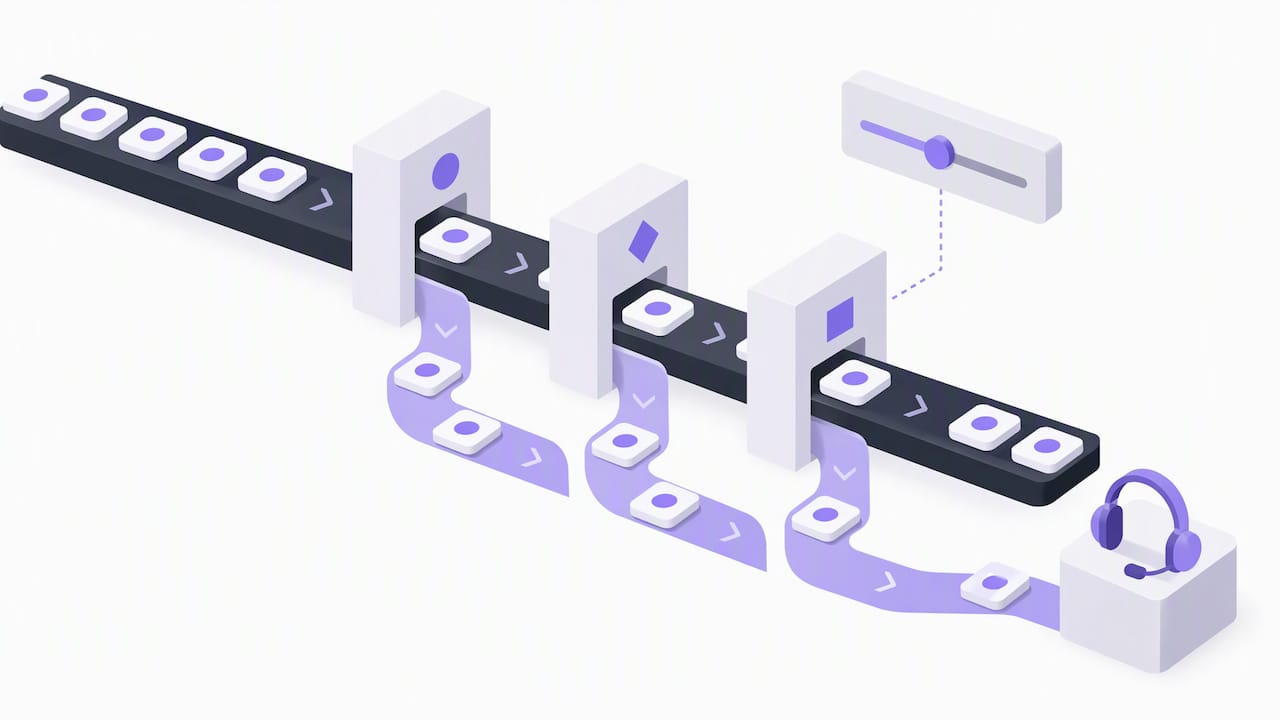
Confidence thresholds should vary by task rather than sit at one global number, as explained in detail by the Master in Artificial Intelligence: Propel Your Career with Metapilot Academy. A query about order status can tolerate a lower bar than a refund request, where a wrong answer costs money. OWASP’s Human Oversight implementation guide recommends starting with basic safety primitives like a kill switch and pause mechanism, then layering approval gates and an escalation matrix on top as the system matures. That phased approach keeps transactional actions, refunds especially, behind a harder approval gate while letting informational queries use lighter, suggestion-style handoffs.
Beyond confidence math, a few signals should always trigger a handoff:
- Explicit request: the user asks for a human, in any phrasing.
- Sentiment shift: frustration or repeated rephrasing signals the bot has stalled.
- Red-flag category: billing disputes, legal threats, or any irreversible action like a cancellation or account deletion.
- Repeated failure: two failed attempts at the same intent should escalate automatically rather than loop a third time.
Progressive escalation, moving from a suggested action to a soft handoff to a hard stop, avoids both over-escalating easy questions and under-escalating risky ones.
What context must travel with the handoff
A handoff without context forces the customer to repeat themselves, which is the single biggest failure mode in AI-to-human transfers. Twilio’s guidance on designing AI-to-human handoffs found that most handoffs fail for exactly this reason, and recommends a three-line summary plus structured fields rather than a wall of raw transcript. More data is not better: a skimmable summary beats an exhaustive log that the receiving agent has no time to read.
At minimum, the payload needs:
- A three-line summary of what the customer wants and what has already been tried.
- A conversation history pointer so the human can pull full detail if needed, without it being forced into the handoff itself.
- Identifiers: customer ID, order number, and channel of origin.
- Structured fields for actions attempted, the confidence score at the point of escalation, and a recommended next step.
Channel continuity matters too. If the conversation started by voice and moves to chat or email, the customer’s profile and history need to sync across that boundary, not just the transcript.
Pro Tip: Write the payload schema before you build the escalation flow. Teams that design the handoff fields first spend far less time debugging why agents keep asking customers to repeat themselves.
Handoff mechanics and protocol patterns
Most of the engineering work lives in a small set of primitives. The Agent Patterns Catalog’s conversation handoff pattern documents this as transferring the entire conversation thread inside a handoff envelope, paired with a return primitive that lets the agent resume once the human resolves the issue.
- Define the event names. A
handoff.initiateevent carries the payload and trigger reason; ahandoff.statusevent reports queued, accepted, or declined; a return primitive hands the thread back to the AI with the human’s resolution notes attached. - Choose the ownership model. Agent-as-proxy keeps the AI visible and able to resume the thread later, which suits support tickets and order issues. Full ownership transfer hands the entire session to the human, which fits legal, billing disputes, or anything where the AI should not re-engage.
- Write the human’s note back into memory. Without this step, the same issue resurfaces on the next contact and the customer explains it all over again.
- Apply sticky routing where it matters. Repeat contacts on the same issue should route to the same human or team when possible, rather than restarting triage each time.
Operational controls: SLAs, timeouts, safety gates and logging
Escalation only works if it is dependable under load, which means setting explicit limits rather than hoping the system behaves. OWASP’s implementation guide recommends defining a maximum response time SLA with a default timeout behavior, since an escalation that waits indefinitely for a human is functionally no escalation at all.
- Set a response SLA and decide the default timeout action: deny, pause, or kill the pending request if no human responds in time.
- Implement a kill switch and pause mechanism so any live session can be stopped immediately if something goes wrong.
- Add approval gates for irreversible actions, refunds, cancellations, account changes, so the AI cannot complete them unsupervised.
- Maintain a documented escalation matrix mapping trigger categories to the team or severity level responsible for each.
- Preserve an evidence trail for every escalation, since auditability is what lets compliance and legal teams verify decisions after the fact.
The FTC’s policy statement on AI accuracy reinforces why this matters beyond internal process: regulators are focused on deceptive claims about AI capability, and a clear, auditable escalation log is part of showing that a system does not overstate what it can handle on its own.
Measuring handoff quality: KPIs and instrumentation
Containment rate alone is a misleading metric. A system can look efficient by resolving more conversations without a human while actually just deflecting customers who give up before reaching a real answer.
Ineffective automation can add noticeable delay before a customer finally reaches escalation, a delay that shows up as frustration even when the eventual resolution looks fine on paper.
Track these instead of relying on containment alone:
- Repeat-explanation rate: how often a customer has to restate information after being transferred.
- Time-to-first-useful-response: the gap between handoff and the human’s first substantive reply, not just their first acknowledgment.
- Resolution rate on escalations: whether the human actually closes the issue, separate from whether the AI deflected it.
- Confidence scoring and rationale at the moment of escalation, logged for later tuning and audit.
Rising containment paired with flat or falling post-handoff resolution is a warning sign: the AI is likely holding onto conversations it should be releasing earlier.
Illustration from an e-commerce voice-agent workflow
A concrete example makes these patterns easier to apply. Picture a WooCommerce store where a customer calls about a delayed order and then asks for a refund. The voice agent looks up the order in real time, confirms the delay, and handles that part on its own. The refund request crosses a red-flag category, a transactional, irreversible action, so it triggers a hard handoff rather than a suggestion.
At that point, the payload matters more than the routing logic:
- Order data and transcript travel with the handoff so the human agent sees exactly what the AI already confirmed.
- A confidence score and recommended action (“refund request, 72% confidence, recommend approval”) let the human fast-decide instead of re-investigating from scratch.
- Profile writeback ensures the resolution gets saved, so a follow-up call does not start from zero.
This is the kind of flow our own AI voice agents for e-commerce are built around: real-time order lookup paired with a warm handoff when a request needs human judgment. Teams piloting a similar setup should measure repeat-explanation rate and resolution time from week one, not just call volume handled.
Governance perspective: how escalation policy should evolve
Autonomy should expand only as fast as testing and audit trails justify it, never ahead of them. Treat every escalation as a learning event: the trigger that fired, the confidence score, and the human’s correction all belong in a feedback loop that retrains thresholds, not just a log that gets archived. A governance process that leaves out legal and compliance review tends to discover its blind spots the expensive way, after a mishandled refund or a disputed charge rather than before one.
— Orphora AI
Orphora AI: a practical option for e-commerce voice-agent handoffs
If you run a WooCommerce store and want these patterns built in rather than built from scratch, AI voice agents can handle order status, returns, and shipping questions around the clock, then hand off to a human the moment a request crosses into refund or dispute territory.

- Real-time order and customer data means the handoff payload is already populated when a human picks up.
- Natural voice conversation without speech-to-text lag keeps the AI-handled portion of the call fast.
- Pay-per-use pricing starts at $9.99 per month per agent plus $0.10 per conversation minute, so piloting one store location costs little to test.
See the full feature set and integration details and reach out to start a pilot on your own order and return flows.
FAQ
When should an AI system hand off to a human agent?
Hand off whenever a confidence threshold is missed, the customer explicitly asks for a person, or the request falls into a high-stakes category like billing, legal, or an irreversible action. Transactional requests such as refunds generally need a harder approval gate than informational questions like order status, according to OWASP’s human oversight guidance.
What information should travel with an AI-to-human handoff?
The handoff needs a short summary of the issue and what has been tried, a pointer to the full conversation history, customer and order identifiers, and a recommended next step with its confidence score. Twilio’s handoff design guidance recommends a three-line summary over a raw transcript dump, since a skimmable format is what actually prevents repeat explanation.
Is AI taking over humans in customer support?
AI is handling a growing share of routine, repeatable requests like order status and basic troubleshooting, but high-stakes and emotionally charged interactions still route to people. The practical model emerging across support teams is human-in-the-loop, where AI handles volume and escalates judgment calls rather than replacing human oversight outright.
What are human skills that AI cannot replace in support interactions?
Skills like reading emotional nuance, exercising judgment on ambiguous or high-stakes cases, negotiating exceptions, and taking accountability for a final decision remain squarely human. These are exactly the categories that should trigger escalation rather than stay inside an automated flow.
How do you measure whether an escalation process is working?
Track repeat-explanation rate, time-to-first-useful-response after handoff, and resolution rate on escalated conversations rather than relying on containment rate alone. A pattern of rising containment with flat post-handoff resolution usually means the AI is holding onto conversations longer than it should.
Sources
- How to design an AI-to-human handoff that preserves context | Twilio
- Federal Trade Commission’s Proposed Policy Statement Concerning the Suppression of Accuracy In Artificial Intelligence Systems