

Keep Calls Fast: Knowledge Base Voice Integration for Ecommerce Ops
Engineering playbook for knowledge base voice integration in eCommerce. Patterns to cut latency with dual agent prefetch and NIST/FCC compliance steps.


Yes, attach a knowledge base to your voice agent when answers depend on facts that change or vary by customer. Use direct context injection for small, static knowledge bases, and move to retrieval-augmented generation with prefetching and a semantic cache once the content grows or latency matters. The real trade-off is grounding versus speed, and any system using AI-generated voice also needs to handle consent and disclosure under current telephony rules.
TL;DR:
- Systems using retrieval-augmented generation with prefetching and caching are best suited for large, frequently updated knowledge bases where latency impacts conversation flow.
- Structuring and tagging source content appropriately, including consolidating related documents and using metadata, is essential for accurate and efficient retrieval.
- Knowledge bases should be maintained like code, with version control and automated updates to prevent drift and ensure accuracy over time.
- Legal compliance mandates obtaining prior express consent and providing clear disclosures for AI-generated voice calls, with strict data encryption and access controls for sensitive information.
Table of Contents
- What knowledge base integration for voice agents actually means
- Comparing architectures: direct injection, RAG, and dual-agent prefetching
- Preparing documents so retrieval stays accurate
- Hitting latency targets without breaking the conversation
- Keeping voice answers grounded and compliant
- Launch checklist and ongoing maintenance
- Connecting the knowledge base to existing support platforms and CRMs
- Securing voice data in transit and at rest
- Measuring whether the integration is working
- Supporting multiple languages without breaking retrieval
- Orphora AI perspective: lessons from e-commerce voice agent deployments
- Orphora AI for WooCommerce stores
- Sources
- FAQ
What knowledge base integration for voice agents actually means
Knowledge base integration means giving a voice agent access to structured content beyond its training data: FAQs, product specifications, return policies, shipping rules, and live order data. Instead of guessing, the agent retrieves the right passage or record before it answers.
This matters for domain-specific questions a general language model can’t know on its own, like a store’s exact return window or a customer’s current order status. It also matters for anything that needs a real-time lookup rather than a static fact, such as checking whether an item shipped.
Skip the integration when the use case is trivial (simple greetings, routing to a human) or when latency tolerance is near zero and the content barely changes. In those cases, a hardcoded script often outperforms a retrieval pipeline.
Comparing architectures: direct injection, RAG, and dual-agent prefetching
The right architecture depends almost entirely on knowledge base size and how much latency the conversation can absorb.
- Direct context injection loads the entire knowledge base into the prompt. It’s the fastest option because there’s no retrieval step, but it only works for small, stable content sets that fit comfortably in a context window.
- Retrieval-augmented generation (RAG) stores content in a vector database and retrieves relevant chunks per query. It scales to large, frequently updated knowledge bases, but vector lookups typically add 50 to 300 milliseconds per query, and that cost compounds with embedding and generation time.
- Multi-agent routing splits a large domain into specialized sub-agents (billing, shipping, technical support), each with its own narrower knowledge base. This reduces retrieval noise and lets each agent reason over less content.
- Dual-agent prefetch with semantic caching runs a “slow thinker” in the background that predicts likely follow-up questions and prepopulates a cache, while a “fast talker” handles the live conversation. On cache hits, this pattern can cut retrieval latency from roughly 110 milliseconds down to about 0.35 milliseconds, which is what makes RAG viable for real-time voice at scale.
For most production deployments past a handful of documents, RAG plus prefetching and caching is the pattern that holds up under real call volume.
Preparing documents so retrieval stays accurate
Retrieval quality depends on how the source content is structured before it ever reaches the vector database. Vendor engineering guidance consistently points to the same groundwork: consolidate and organize documentation by domain before indexing it, rather than dumping raw files into the system.
- Merge related documents and delete outdated drafts so the agent isn’t retrieving conflicting versions of the same policy.
- Group content by domain (returns, shipping, billing) so retrieval narrows to the right section quickly.
- Chunk documents into semantically coherent pieces, typically a paragraph or a single policy point, with enough overlap that context isn’t cut mid-thought.
- Tag each chunk with metadata and a canonical ID so it maps cleanly to the tool or database call that answers the question, such as an order lookup.
- Automate reprocessing through CI/CD whenever source documents change, so the knowledge base never drifts from what’s actually published.
Pro Tip: Treat your knowledge base like a codebase: version it, review changes, and let automated pipelines push updates instead of manual re-uploads.
Hitting latency targets without breaking the conversation
A voice turn has four latency sources: speech-to-text, retrieval, language model generation, and text-to-speech. Each one adds up, and vector database retrieval alone typically costs 50 to 300 milliseconds before the model has even started generating a response.
Several tactics bring that total down to something that feels conversational:
- Stream speech-to-text and text-to-speech instead of waiting for full transcripts or full responses, which shortens time-to-first-audio.
- Use a prefetch and semantic cache layer so common follow-up questions are already resolved before the user finishes asking.
- Fall back to a direct vector query only on a cache miss, keeping the expensive path rare rather than routine.
- Route foreground conversation turns to a fast, lightweight model while a slower, stronger model handles background reasoning and cache population, a pattern ElevenLabs describes as a dual-brain setup.
Prefetch and semantic caching can reduce retrieval latency from roughly 110 milliseconds to 0.35 milliseconds on a cache hit, which is the difference between a pause the caller notices and one they don’t.
Model selection matters just as much as architecture. A smaller, faster model handling the live turn while a larger model refines answers in the background keeps the call moving without sacrificing the depth of the final response.
Keeping voice answers grounded and compliant
Hallucination is a bigger problem in voice than in text because there’s no screen to double-check against. An agent that invents a return policy over the phone can’t be caught by a glance at a citation.
- Run an LLM-judge style groundedness check that compares the generated answer against the retrieved source before it’s spoken.
- Build explicit refusal behavior for out-of-scope questions, so the agent routes to a human instead of guessing.
- Test pre-deployment with coverage tests across common intents, red-team prompts designed to provoke bad answers, and replay audits against real call transcripts.
- Monitor hallucination rate and content drift continuously, not just at launch.
Pro Tip: Log every retrieval-and-response pair during testing so you can replay exactly what the agent saw when it gave a wrong answer.
Governance here isn’t optional. The NIST AI Risk Management Framework recommends documenting data provenance, running pre-deployment tests, maintaining an inventory of deployed AI systems, and defining acceptable-use policies that include refusal behavior for out-of-scope queries. On the regulatory side, the FCC confirmed in 2024 that TCPA rules apply to AI-generated voice calls, which means prior express consent and clear disclosure that a call uses AI-generated or prerecorded voice are required, not optional.
Launch checklist and ongoing maintenance
Shipping a knowledge-base-enabled voice agent goes smoother with a fixed sequence rather than an ad hoc rollout.
- Confirm consent and disclosure flows are in place before any AI-generated voice call goes live, per current telephony guidance.
- Run test scenarios against latency and accuracy service-level targets, including edge cases and known failure modes.
- Wire up integration points: CRM, order and shipping APIs, telephony connectors, and the webhook or tool mappings that connect retrieved content to live actions.
- Track core metrics from day one: latency, cache hit rate, hallucination rate, customer satisfaction, and automation rate.
- Set a maintenance cadence for automated knowledge base reprocessing, a documented rollback plan, and an incident response process for when something goes wrong in production.
Treat the checklist as a living document. A knowledge base that isn’t revisited on a schedule degrades quietly, usually right as the underlying policies it describes change.
Connecting the knowledge base to existing support platforms and CRMs
A voice agent’s knowledge base rarely lives in isolation. It needs to sit alongside whatever support desk and CRM the team already runs, pulling live customer and order context rather than relying on static documents alone.
The practical pattern is to treat the CRM or support platform as a source of truth that the agent queries in real time, while the knowledge base handles policy and procedural content that doesn’t change per customer. A return policy lives in the knowledge base; whether a specific order is eligible for that policy lives in the order system, fetched live.
This split matters for accuracy. A knowledge base that tries to store customer-specific data goes stale immediately, while a CRM integration that tries to answer general policy questions ends up duplicating content that belongs in the knowledge base. Keeping the two separate, with clear handoffs through API calls or webhooks, avoids both problems.
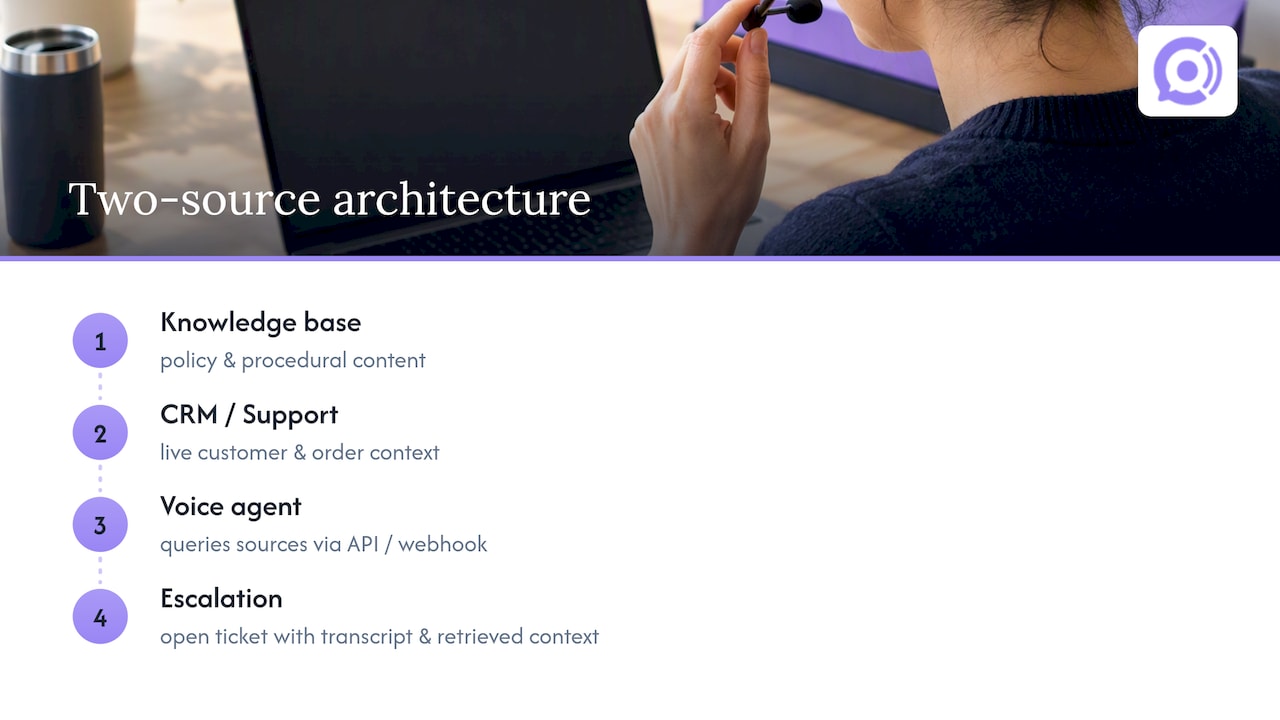
Ticket escalation is the other piece. When a voice agent can’t resolve a query from either source, it needs a clean path to open a ticket in the existing support platform with the call transcript and retrieved context attached, so a human agent isn’t starting from zero. Vendor guidance on structuring knowledge for AI use cases points to the same principle: the knowledge base and the operational systems around it should be designed to complement each other, not duplicate the same information in two places.
Securing voice data in transit and at rest
Voice calls carry sensitive information: order numbers, addresses, sometimes partial payment details depending on what a customer says aloud. That data needs the same protection as any other customer record, arguably more, because a transcript can capture things a customer wouldn’t type into a web form.
Calls should be encrypted in transit using standard telephony and API-layer encryption, and recordings or transcripts stored at rest should be encrypted as well, with access restricted to systems and people who need it for support or quality review. Retention policies matter here too: keeping call recordings indefinitely increases exposure with no corresponding benefit, so a defined retention window tied to actual business need is worth setting early.
Access control extends to the knowledge base and retrieval layer itself. If the agent can pull order details through a tool call, that call needs the same authentication and scoping a human support agent would be held to, not a blanket API key with broad access. Logging matters for both security and debugging, but logs containing customer data need their own access restrictions rather than sitting in a general-purpose log aggregator.
The consent and disclosure requirements tied to AI-generated voice calls aren’t just a compliance checkbox. They intersect with data handling directly, since a disclosed, consented call creates a clearer record of what was collected and why, which matters if a customer later asks what data was captured during a call.

Measuring whether the integration is working
Latency and accuracy are the two numbers that matter most day to day, but neither tells the whole story on its own.
Cache hit rate shows how often the prefetch layer is resolving queries before they hit the expensive retrieval path, and a low hit rate usually means the prediction model behind the cache needs retuning. Hallucination rate, tracked through groundedness checks or audited call samples, shows whether the agent is staying inside its knowledge base or drifting into invented answers.
Automation rate, the share of calls resolved without human handoff, is the metric that ties directly to cost savings, but it needs to be read alongside customer satisfaction rather than instead of it. A high automation rate paired with falling satisfaction usually means the agent is closing calls it shouldn’t.
Time-to-first-audio is worth tracking separately from total call latency, since it’s the number that most affects how a caller perceives responsiveness even before the full answer arrives. Together, these metrics give a clearer read on integration health than any single number in isolation.
Supporting multiple languages without breaking retrieval
A knowledge base built for one language doesn’t automatically work in another, even with a translation layer bolted on. Idioms, policy phrasing, and even the structure of a return policy can differ enough between languages that a direct translation produces technically correct but practically confusing answers.
The more reliable approach is maintaining language-specific knowledge base entries rather than relying on real-time translation of a single source, especially for anything involving legal or policy language where precision matters. Retrieval also needs to match the query language to the right language’s content, which means the embedding and retrieval layer has to be language-aware rather than assuming everything runs through one model.
Speech recognition and synthesis add their own layer of complexity, since accents and regional phrasing within the same language can affect transcription accuracy well before the knowledge base is even queried. Testing across the specific languages and accents a deployment actually expects to handle catches more problems than testing against a generic multilingual benchmark.
Orphora AI perspective: lessons from e-commerce voice agent deployments
Most of the knowledge-base debate in voice engineering focuses on general support. E-commerce narrows it: the hardest questions aren’t abstract policy, they’re live and specific, like “where’s my order” or “can I still return this.” That’s exactly where a knowledge base paired with real-time data access earns its place, handling policy questions while order and shipping lookups pull live records instead of static text.
— Orphora AI
Orphora AI for WooCommerce stores
Orphora AI builds AI voice agents specifically for WooCommerce stores, combining knowledge base support with real-time order data access so customers get answers on returns, shipping, and order status without waiting on hold. Guardrail workflows keep order-related actions within defined limits rather than letting the agent improvise.

Plans start with the AI Voice Agent plan at a low monthly rate per agent, plus a per-minute conversation charge, with an Enterprise plan available for larger deployments. Check availability and see the full feature set on the Orphora AI features page.
Sources
- FCC: FCC confirms TCPA applies to AI technologies that generate human voices
- Artificial Intelligence Risk Management Framework: Generative Artificial Intelligence Profile — NIST
- Deploying enterprise knowledge to voice agents — ElevenLabs blog
FAQ
What is knowledge base integration for a voice agent?
Knowledge base integration gives a voice agent access to structured content like FAQs, policies, and product data so it can answer accurately instead of relying only on general training. It typically works through direct context loading for small content sets or retrieval-augmented generation for larger, frequently updated ones.
How do you connect a knowledge base in a platform like Voiceflow?
Platforms like Voiceflow let you upload documents or connect a data source, then the platform handles chunking and retrieval behind the scenes when a user query comes in. The setup still benefits from the same prep work: consolidated documents, clear domain grouping, and metadata that maps content to any live lookups the agent needs to perform.
Is there a voice-activated AI that works with a knowledge base?
Yes, several voice agent platforms combine speech recognition with knowledge base retrieval, including systems built for specific industries like e-commerce customer support. Orphora AI, for example, pairs voice interaction with a knowledge base and real-time order data for WooCommerce stores.
What should I look for in a knowledge base tool for voice AI?
The strongest tools support structured document consolidation, metadata tagging, and either direct injection or retrieval-augmented generation depending on content size. Low retrieval latency and support for caching or prefetching matter most for real-time voice specifically, since a slow lookup breaks the conversational flow.
Does using AI-generated voice require special legal disclosures?
Yes, the FCC confirmed that TCPA rules apply to AI-generated voice calls, requiring prior express consent and clear disclosure when a call uses AI-generated or prerecorded voice. This applies regardless of how well the underlying knowledge base integration performs.