
AI Voice ROI: Calculate WooCommerce Payback With 7 Inputs
Build a copyable AI voice ROI model with seven inputs, test conservative to aggressive scenarios, and see how the numbers map to a WooCommerce deployment.


AI voice agents produce positive ROI often, but not automatically: the outcome hinges on your automation rate, your AI price per minute, and how often calls escalate to a human. Get those three inputs right and the payback math usually favors automation within months. Below we walk through a copyable cost model, worked scenarios, and the metrics that confirm whether your deployment is actually paying off.
TL;DR:
- Compare fully loaded human costs, including benefits, training, supervision, occupancy, and shrinkage, against AI minutes, subscriptions, telephony, setup, and escalation labor.
- In the worked example, automating 14,400 of 24,000 annual calls saved about $31,680 yearly, recovering a $5,000 setup cost in under two months.
- Typical order status and returns assume 60% automation, 10% escalation, and two to six month payback; complex call mixes may need six to twelve months.
- Require a 30 to 90 day pilot when payback shifts sharply under sensitivity tests, and track escalation, repeat contacts, CSAT, and first contact resolution.
Table of Contents
- What to Include When Comparing Human and AI Call Costs
- The Copyable ROI Model: Inputs and Formulas
- Which KPIs Confirm Whether the ROI Is Real
- Running the Calculator and Reading Sensitivity Results
- Benchmark Scenarios: Conservative, Typical, and Aggressive
- Orphora AI Mapped to a WooCommerce Deployment
- What Procurement Teams Often Get Wrong
- Try the Model With Your Own Numbers
- FAQ
- Sources
What to Include When Comparing Human and AI Call Costs
Most ROI estimates fail at the starting line because they compare a human agent’s hourly wage to an AI vendor’s sticker price. That comparison misses most of the real cost on both sides.
A fully loaded human agent costs far more than base wage. The honest tally includes:
- Base wage plus payroll taxes and benefits, which typically add a meaningful percentage on top of salary.
- Recruiting and training costs, amortized over the agent’s expected tenure given typical contact center attrition.
- Management and quality assurance overhead, since every agent needs a supervisor reviewing calls.
- Occupancy, equipment, and software seat costs for the workstation and tools.
- Shrinkage: paid time that isn’t spent on calls, including breaks, meetings, and absenteeism.
AI-handled calls carry a different cost structure. You need to account for:
- Per-minute conversation fees charged by the voice AI vendor.
- Platform subscription fees for the agent license itself.
- Telephony minutes, since voice calls route through a carrier regardless of who answers.
- Integration and one-time setup costs: connecting order data, building escalation logic, and testing.
The side most ROI models skip entirely is the opportunity side. Faster answers reduce abandonment, which means fewer customers hang up before resolution. Recaptured revenue from avoided cart abandonment or expedited returns processing counts as a real financial benefit. Some deployments also use voice interactions to surface upsell or cross-sell moments, though that revenue should be modeled conservatively since not every program captures it.
The Copyable ROI Model: Inputs and Formulas
Build this model with seven inputs, and you can compute savings, payback period, and a simple net present value for any deployment.
- Annual call volume: total inbound calls your support line handles per year.
- Baseline human average handle time (AHT): minutes per call under current staffing.
- Percent automatable: the share of calls an AI agent can fully resolve without a human.
- AI price per minute: your vendor’s conversation rate, such as the $0.10 per minute some platforms charge.
- Escalation rate: the share of AI-handled calls that still require a human handoff.
- One-time implementation cost: setup, integration, and testing fees paid up front.
- Discount rate: the rate you use to convert future savings into present value, typically your cost of capital.
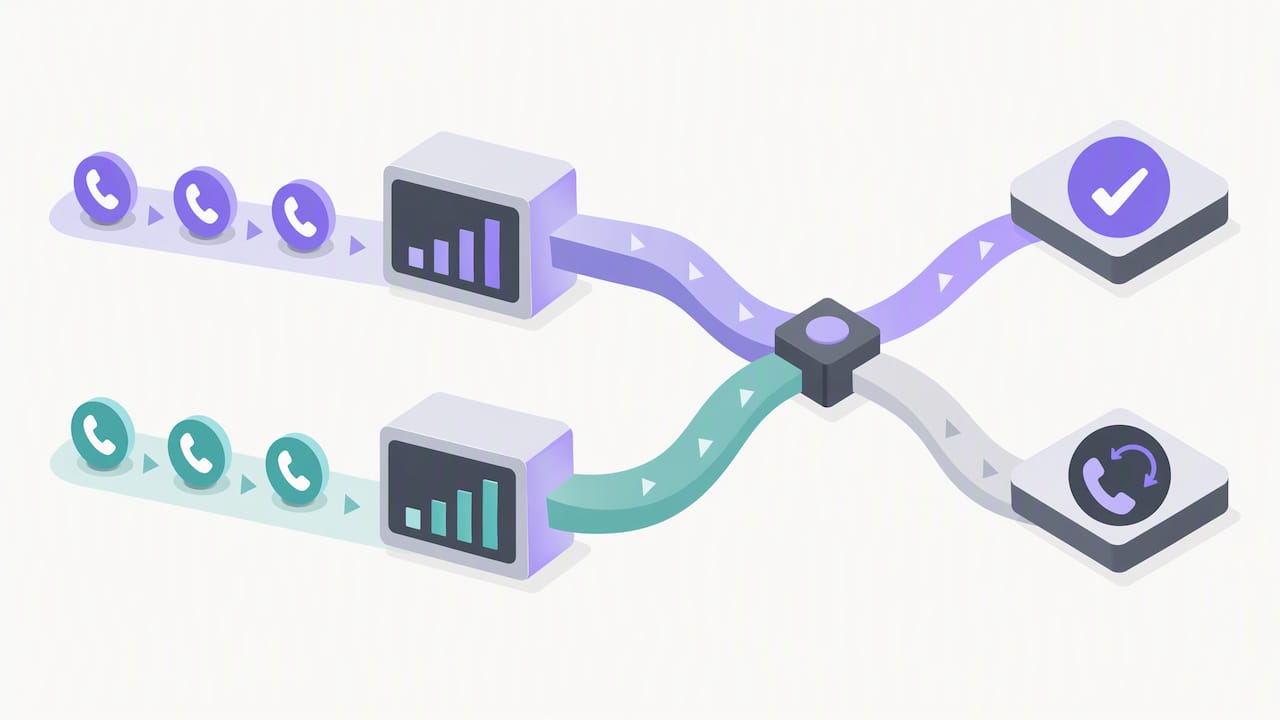
The formulas are straightforward. Cost per human call equals fully loaded hourly agent cost divided by 60, multiplied by AHT in minutes. Cost per AI call equals AI price per minute multiplied by AI-handled AHT, plus a weighted share of escalated calls priced at the human rate. Annual savings equals the number of calls automated multiplied by the cost difference between a human-handled call and an AI-handled call. Payback period equals one-time implementation cost divided by monthly savings. A simple NPV sums discounted annual savings over the deployment’s expected life and subtracts the implementation cost.
Worked mini-example: say a store handles 24,000 calls per year, with a human AHT of 6 minutes and a fully loaded agent cost of $25 per hour. That puts the human cost per call at $2.50. Automating 14,400 of those calls at a savings of roughly $2.20 per call yields about $31,680 in annual savings. Against a $5,000 one-time setup cost, payback arrives in under two months.
Field experiments show agentic AI speeds up routine service interactions, though speed alone doesn’t guarantee better outcomes, according to Dartmouth’s Tuck School of Business. That’s why the model needs a KPI layer, not just a cost layer.
Which KPIs Confirm Whether the ROI Is Real
Cost savings on paper mean little if customer experience erodes. Track three categories side by side.
Financial KPIs:
- Cost per handled contact and cost per resolved contact, since a cheap call that fails to resolve anything isn’t a savings.
- Payback period and total cost of ownership (TCO), including ongoing subscription and per-minute fees over the contract term.
Operational KPIs:
- Automation rate and AHT, measured separately for AI-handled and human-handled calls.
- Escalation rate, abandonment rate, and repeat-contact rate, which flags whether customers are calling back because the AI didn’t actually solve the problem.
Customer KPIs:
- CSAT, NPS, and first-contact resolution (FCR), tracked before and after deployment.
- Complaint incidence, since research on service interactions indicates customers may exaggerate complaints more with less humanlike AI agents, an effect that anthropomorphic design and perceived competence can reduce, according to a West Virginia University research repository study.
Governance metrics belong in the same dashboard, with tools offering independent AI agent audit and assurance to verify compliance and performance. NIST’s AI Risk Management Framework recommends continuous measurement under its MEASURE function, including failure and confabulation rates, because trust erosion is a cost that doesn’t show up in a simple savings calculation until it compounds.
Pro Tip: Instrument escalation rate and repeat-contact rate from day one of your pilot. Those two numbers reveal whether automation is actually resolving issues or just deferring them.
Running the Calculator and Reading Sensitivity Results
Once your model is built, treat it as a live tool rather than a one-time estimate.
- Paste your actual call volume, AHT, and fully loaded agent cost into the baseline inputs first.
- Enter your vendor’s per-minute price and your current estimate of automation rate in the AI-side cells.
- Let the formulas compute cost per call, annual savings, and payback period automatically.
- Run three sensitivity checks before trusting the output: flex automation rate up and down by 10 to 20 percentage points, flex AI price per minute by 20%, and flex escalation rate by 50% in either direction.
- Compare the resulting payback range across all three checks rather than relying on a single point estimate.
If payback stays under six months across every sensitivity scenario, you have a strong case to move toward procurement. If payback swings wildly, for example from two months to over a year depending on escalation rate, that volatility signals you need a pilot first to nail down your real automation rate before committing to a larger contract.
Benchmark Scenarios: Conservative, Typical, and Aggressive
Three reusable scenarios give you a starting point before you plug in your own numbers.
- Conservative: 40% automation rate, 15% escalation rate, AI price per minute at the higher end of typical vendor pricing. Expect payback in the 6 to 12 month range, appropriate for complex call mixes with high-value transactions.
- Typical: 60% automation rate, 10% escalation rate, mid-range per-minute pricing. Payback often lands between 2 and 6 months for straightforward order-status and returns inquiries.
- Aggressive: 75% to 80% automation rate, under 5% escalation rate, achievable mainly for narrow, well-scoped call types like order tracking. Payback can arrive in under two months, though this scenario depends on a tightly pruned knowledge base and low call complexity.
Published vendor case studies and total economic impact reports show wide variance in reported ROI, so treat any single published figure as a ceiling rather than an expectation, and validate it against your own call mix. Call complexity matters more than volume: a store fielding mostly “where’s my order” questions will automate at a higher rate than one handling disputed charges or damaged-item claims.
Orphora AI Mapped to a WooCommerce Deployment
Our voice agents integrate directly with WooCommerce, pulling real-time order and customer data so calls about order status or returns resolve without a transcript delay or a human handoff. Pricing runs on a $9.99 per month per-agent subscription plus $0.10 per conversation minute, which plugs straight into the per-minute variable in the cost model above.
For a mid-size store handling 20,000 calls a year with a 55% automation rate on order-status and returns questions, the model above suggests payback inside three to five months using conservative assumptions.
To protect call quality as automation scales, we recommend:
- Pruning your knowledge base to the highest-frequency questions, since keeping a voice bot’s knowledge base under roughly 200 FAQs keeps lookup latency low.
- Setting early escalation triggers for frustration signals rather than waiting for a failed resolution, following the escalation design guidance that prevents repeat contacts.
- Running ongoing call-quality monitoring to catch drift in automation accuracy before it shows up in CSAT.
What Procurement Teams Often Get Wrong
Treat every calculator output as a confidence range, not a guarantee, and require a 30 to 90 day pilot before signing a multi-year contract. Research on emotion-aware agents found that simulated empathy can trigger customer reactance and lower service evaluations, so prioritize competence and clear escalation paths over scripted warmth.
Build your contract around measurable SLAs: data access terms, escalation response times, and a fixed measurement cadence for reviewing automation rate and CSAT together. A vendor unwilling to commit to those terms is telling you something about confidence in their own numbers.
— Orphora AI
Try the Model With Your Own Numbers
We built our voice agents around the same cost structure this model assumes: pay-per-minute conversation pricing with no long-term contract, real-time order lookup integration, and configurable escalation controls.

If the scenarios above look close to your call mix, the fastest way to know for sure is to run your own numbers through the model and compare them against a short pilot.
- Plug your call volume, AHT, and current staffing cost into the formulas from the cost model section.
- Review how WooCommerce integration and escalation controls map to your current support workflow.
- Start a pilot on the AI Voice Agent plan to validate automation rate before scaling to additional agents.
FAQ
What Is the 30% Rule for AI?
When evaluating your own deployment, rely on your actual automation rate and cost inputs rather than a borrowed rule of thumb.
Does AI Voice Monetize?
AI voice agents monetize primarily through labor cost avoidance on automated calls, plus secondary gains like reduced cart abandonment and faster return processing. Pricing models like per-minute conversation fees make the direct cost side easy to track against those savings.
Is There Any ROI on AI?
AI voice deployments often deliver positive ROI when automation rate is high enough and escalation rate stays low, as the worked example in the cost model section shows. The outcome depends on your specific call mix, so running the model with your own numbers before committing is the only reliable way to confirm it.
Can I Sell My Voice for AI?
This question falls outside the scope of business voice-agent ROI and relates instead to personal voice licensing arrangements, which carry their own legal and consent considerations unrelated to customer support automation.
Sources
- NIST AI Risk Management Framework — MEASURE resources
- Even With Humans in the Loop, Agentic AI Systems Struggle | Tuck School of Business
- The Impact of AI Service Workers on Opportunistic Complaint Behavior (research repository)