

Brand Voice Guidelines: How to Write a Guide Your Team Will Use
Learn what to put in brand voice guidelines, how to separate voice from tone, and how to apply them to email, support and phone calls, with examples.


Brand voice guidelines are a short document that tells everyone who writes or speaks for your company how it should sound: the personality behind the words, the vocabulary you prefer, the phrases you avoid, and how the delivery shifts from a product page to an angry customer email. The best ones fit on one to four pages, use real before-and-after examples, and cover every channel customers touch, including the phone.
This guide walks through what to include, how to choose your traits, what good examples look like, and how to keep the result consistent when more than one person (or an AI) is writing.
TL;DR
- Voice is your brand’s stable personality. Tone is how that voice adjusts to the audience and the moment. Document both, separately.
- Pick three to five traits and give each a “sounds like” and “never sounds like” example. Adjectives alone don’t guide anyone.
- Cover every channel, including support emails, error messages and phone scripts, not just marketing copy.
- Give AI tools the same guide, with concrete preferred and discouraged wording, and keep a human review step.
- Assign a named owner and check real content against the guide on a schedule.
Table of Contents
- Voice vs. tone: the difference that shapes the whole document
- What to include in a brand voice guide
- How to define your traits in five steps
- Brand voice examples: traits with wording attached
- Tone by situation and channel
- Your voice on the phone: greetings, pacing and AI agents
- Where Orphora AI fits
- Keeping the voice consistent as more people write
- Using brand voice guidelines with AI tools
- Our perspective: write the guide so it can be spoken
- FAQ
- Sources
Voice vs. tone: the difference that shapes the whole document
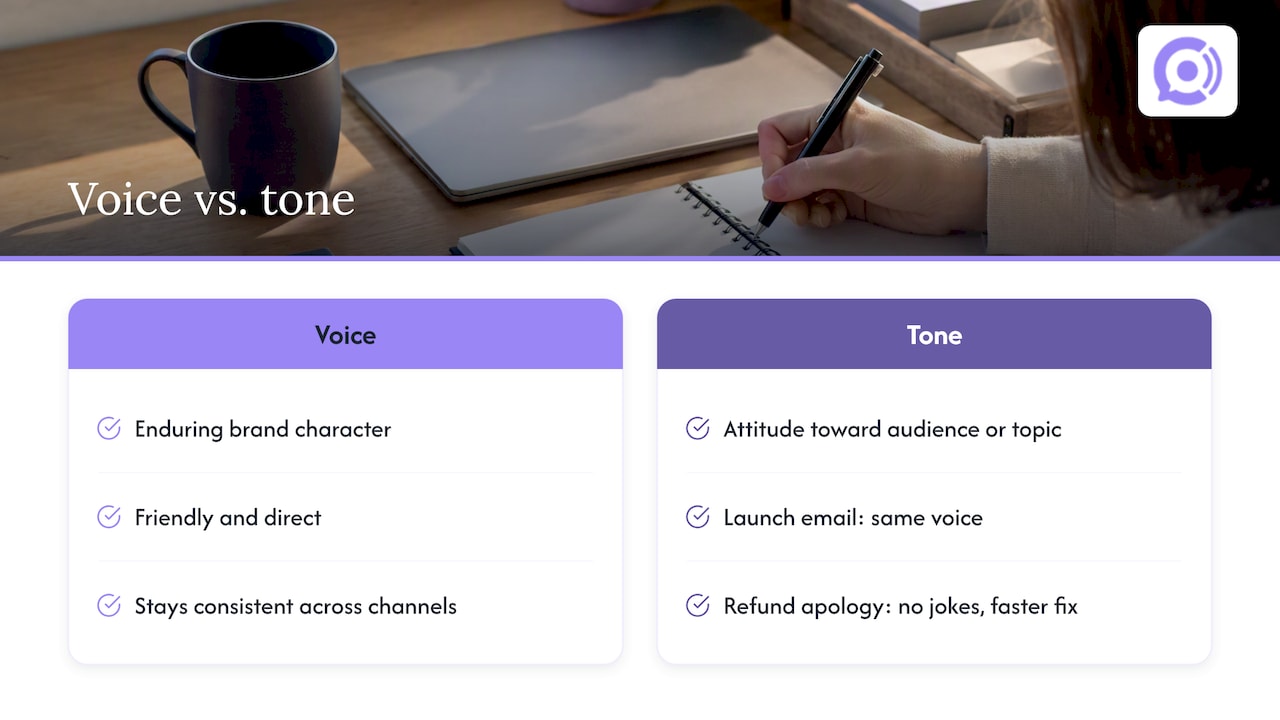
Most confusion in brand guides starts here, so settle it first. Public university and government style guides state it plainly. NC State’s brand guidance describes voice as an organization’s unique, enduring character, while tone reflects the current attitude toward an audience or topic and can change with the occasion. Pennsylvania’s authoring guide puts it the same way: voice is personality and stays consistent across channels, while tone is word choice, style and emotional register adjusted for the audience and task.
A practical way to hold the two apart: voice is who you are, tone is how you act in a given room. A friendly, direct brand sounds the same in a launch email and a refund apology, but the apology drops the jokes and gets to the fix faster.
The University of Arizona gives a useful picture: a commencement speech, a crisis update and an Instagram caption can all differ while still sounding like the same institution. That is the goal. People should recognize you without every message sounding identical.
Write the two in different parts of your guide. Voice gets a fixed statement and traits. Tone gets a situational map, covered below.
What to include in a brand voice guide
There is no single required format, and sources differ on length. A Stanford course guideline shows a one-page document can cover personality, verbal style and visual style, with verbal style addressing language, tone, contractions, slang, humor and pronunciation. Notice that last item. Pronunciation matters the moment your brand speaks aloud.
For a working guide at a small or mid-sized company, these parts earn their place:
- A voice statement. One or two sentences connecting your positioning, your audience and how you behave in writing. Asana recommends pairing a statement with three to five characteristics, an explanation of how each sounds, and do-and-don’t guidance.
- Three to five traits, each as behavior. More than five and nobody remembers them.
- Language rules. Contractions or not, sentence length, how you handle slang, jargon, humor and emoji, capitalization, and how you refer to customers.
- A word list. Preferred terms and banned phrases. A brand lexicon of preferred and prohibited words is one of the elements this practitioner guide recommends, along with tone guardrails and inclusive-language guidance.
- A tone map. How the voice shifts by situation and channel.
- Proof and claims. The messaging hierarchy, approved claims and proof points, so writers don’t improvise promises. Prose suggests including these along with audience priorities and editing standards.
- An owner and a review process. Covered in the consistency section.
The temptation is to build a 40-page brand bible. Resist it. A guide that nobody opens is worse than a two-page guide that everyone follows.
How to define your traits in five steps
1. Start from your business, not from adjectives
Amazon Ads suggests starting with mission, values, audience, differentiators and personality traits, then using a voice chart to mark which characteristics you want and which you want to avoid. BrandLife adds that voice should connect to purpose, positioning, values and the vocabulary your audience actually uses, not to unsupported personality adjectives.
If you sell replacement parts to people mid-repair, “playful” is probably wrong. “Calm, precise, quick” is closer.
2. Describe the reader in detail
Write down who reads you, what frustrates them and what they want to achieve. Adobe’s guidance covers demographics, psychographics, behavior, pain points, needs and aspirations, then narrows a long trait list to a few that fit both the brand’s identity and the audience’s appeal.
3. Keep traits both true and aspirational
The same Adobe guidance argues traits should be authentic and aspirational: they must reflect real values and capabilities while expressing the identity you want recognized. If your support team takes three days to reply, don’t write “instantly responsive” into the voice. Fix the operation first or choose a different trait.
4. Turn each trait into an instruction
Glean recommends expressing traits as behaviors: open with the answer, state outcomes before methods, avoid unnecessary hedging. Humans and AI tools can follow those. Nobody can reliably follow “be authentic.”
5. Add “is” and “is not” boundaries
BrandLife’s approach pairs each of three to five behavioral principles with what it is and is not. “Friendly, not chatty” tells a writer where the line sits.
Brand voice examples: traits with wording attached
Good examples pair a trait with instructions and prohibitions. NC State’s “confident” voice uses plain, uncomplicated language and clear claims, and avoids passivity, hesitation, fear, hedging, needless qualifiers and vague conclusions.
Here is a sample table for a hypothetical online store. These are illustrations of the format, not quotes from any company.
| Trait | Sounds like | Never sounds like |
|---|---|---|
| Direct | “Your order ships Thursday.” | “We’re hoping to get your order out sometime this week.” |
| Warm | “Sorry about the wait. Here’s what we’re doing about it.” | “We apologize for any inconvenience this may have caused.” |
| Plain-spoken | “You can return it within 30 days.” | “Returns are accepted subject to the conditions herein.” |
| Helpful | “Want me to email you the tracking link?” | “Please refer to our FAQ page.” |
The left column is what trains people. For a deeper look at calibrating “friendly” into testable rules, this piece on turning a vague trait into rules is a good companion.
Tone by situation and channel
Once voice is fixed, build the tone map. MOO’s guidance says tone-of-voice guidelines should give practical support across touchpoints, listing websites, email, advertising, social media, error messages, notifications and call-center scripts. Many guides stop at marketing and forget the last three, which are where customers are most stressed.
A compact tone map for a store might look like this:
| Situation | Tone adjustment | Example move |
|---|---|---|
| Product page | Confident, brisk | Lead with the benefit, skip filler |
| Order confirmation | Reassuring, factual | State what happens next and when |
| Delay or damage | Serious, accountable | Apologize once, then offer the fix |
| Refund or return | Patient, step-by-step | One action per sentence |
| Social reply | Lighter, short | Contractions fine, humor only if the customer starts it |
Glean also suggests numerical anchors by scenario, such as rating energy and formality on a scale, to reduce tonal drift in AI-generated content. A simple 1-to-5 scale for formality and energy in each row of your tone map takes ten minutes and removes a lot of argument. Distinctly recommends channel guidance for social, email and blogs with examples, do’s and don’ts, and advice on adapting without losing recognizability.
If your team spreads voice across several technology-led channels, this template for one-to-four-page guides shows how compact a guide can stay.
Your voice on the phone: greetings, pacing and AI agents
Phone is the channel most guides ignore, and the one where voice is most literal. The keywords people search, such as a custom phone greeting or AI voice tone, point at the same need: a spoken version of the guide.
Written rules do not translate directly. Spoken language needs shorter sentences, no parenthetical asides, numbers read in chunks, and confirmation of key details (“That’s order 1042, shipped Monday, right?”). A caller can’t skim back. Decide these in advance:
- The greeting. Name, brand, an offer to help, in under five seconds. Skip the legal paragraph.
- Pacing and pauses. Where the agent confirms a detail, and how it handles a caller who interrupts.
- Pronunciation. Product names, brand names, street names.
- Apology and escalation phrasing. Who says what when a human takes over. Our notes on AI-to-human escalation cover how to avoid making callers repeat themselves.
- What the agent never says. Promises about refunds it cannot approve, guesses about delivery dates.
If you run an online store, the phone channel is also where tone mistakes cost most, because the caller usually has a problem. Our guide to what to configure first in AI support and our pre-launch testing playbook show how to turn written voice rules into tested behavior. Spoken style also differs from written style in ways that surprise teams; see why read speech falls short in conversation.
Where Orphora AI fits
If you run a WooCommerce store and want your phone support to follow the voice you just documented, Orphora AI provides AI voice agents that answer calls around the clock, look up orders and customer data in real time, and handle questions like order status, returns and shipping. You can customize the agent, connect a knowledge base, and review call recordings and transcripts to check that what it says matches your guide.
The AI Voice Agent plan is $9.99 per month per agent, plus $0.10 per conversation minute. An Enterprise plan is available without a published price. See the features or start from the main page.

Write the greeting and escalation lines from your guide first, then test the agent against them before launch.
Keeping the voice consistent as more people write
The Pennsylvania guide’s rule is simple: keep voice consistent across communications regardless of who writes, and adjust tone to the audience, task and emotional state. In practice, consistency fails for boring reasons: nobody owns the guide, new hires never see it, and examples go stale.
What works:
- Modular structure. Prose describes a core guide (voice, principles, messaging, language, editing standards) with channel add-ons and reusable templates. Update the add-ons often and the core rarely.
- Content checks. Amazon Ads recommends implementing voice through content examples and regular consistency checks across blog posts, social posts and other communications. Pull five recent pieces each quarter and mark them against the traits.
- Named reviewers and a rubric. BrandLife recommends named reviewers, approval steps and a repeatable scoring rubric so consistency does not rest on one person’s memory.
- Real samples. Replace invented examples with good ones your team has actually shipped.
If your positioning is still fuzzy, firm it up before the voice. This brand positioning workshop outline is a quick way to get there, because voice follows from who you are for and what you promise.
Using brand voice guidelines with AI tools
AI writing tools will produce something fluent and generic unless you give them the guide. Prose recommends using AI for outlines, variations, rewrites, approved-source summaries and repackaging, with stronger human review for positioning, sensitive stories, executive bylines, regulated claims and opinionated content.
Two details make the biggest difference:
- Mechanics. WordStream notes that sentence length, punctuation, contractions, formatting, capitalization and emoji rules materially affect AI output. Put them in the guide in plain terms.
- Paired examples. The same source recommends concrete preferred-versus-discouraged wording and scenario-specific tone examples. Three good pairs beat a page of adjectives.
Glean’s view is that separating voice, tone and audience stops AI from producing context-blind text: voice stays stable, tone changes by situation, and audience decides depth, evidence and vocabulary. If you want to see the failure mode up close, this article on generic, context-blind AI output is relevant. And for generating on-brand content at scale, AI-driven brand building strategies covers the workflow side.
Always read AI output aloud once. If it would sound odd from a person, it will sound odd from a voice agent.
Our perspective: write the guide so it can be spoken
We build voice agents for WooCommerce stores, so we see where written brand guides break: on the phone. A guide that says “warm and professional” gives an agent nothing to act on. What works is a guide that states what the agent says when a caller asks about a late order, when it can’t find an order number, and when it hands off to a person.
We think the most useful voice rules for support are behavioral: answer first, confirm the order detail, say what happens next, and never promise an action the agent isn’t allowed to take. That is why we pair customizable agents with guardrail workflows for order actions, and why we encourage store owners to read transcripts after launch and edit the guide from what real callers said.
One more opinion: keep the guide short enough that you’ll revise it. A two-page guide updated every quarter beats a polished PDF nobody has opened since launch.
— Orphora AI
FAQ
What is the difference between brand voice and tone of voice?
Brand voice is your organization’s consistent personality across all communications. Tone is how that voice adjusts to the audience, the channel and the emotional situation. Your voice stays the same; your tone is softer in an apology and brisker in a shipping update.
How long should brand voice guidelines be?
Long enough to be used, which usually means one to four pages. A one-page version can define personality and verbal style, as the Stanford example shows. Add channel add-ons only when a team needs them.
How many voice traits should a brand have?
Three to five is the range recommended by Asana and BrandLife. Each trait needs a behavioral description and an example of what it is not, or it will mean different things to different writers.
Do brand voice guidelines apply to phone calls and AI agents?
Yes. Call-center scripts are named among the touchpoints tone guidelines should cover, and a voice agent needs even more explicit rules than a human: greeting, pacing, pronunciation and escalation wording. Test the agent against those rules before it takes live calls.
Sources
- Voice and Tone, NC State Brand
- Voice and Tone: What’s the Difference?, Commonwealth of Pennsylvania
- Voice & Tone, University of Arizona
- Brand Voice Guideline, Stanford GSB course
- What is a Brand Voice? Asana
- Brand voice guidelines in an AI era, Prose
- 5 Elements to Include in Your Brand Voice Guidelines
- What is Brand Voice? Amazon Ads
- Brand Voice Guide, BrandLife
- Brand personality traits, Adobe
- How to create a brand voice guide for AI tools, Glean
- How to develop a brand tone of voice guideline, Distinctly
- AI Brand Guidelines, WordStream