

Encrypted Call Recordings: How to Protect and Retain Them
What encrypted call recordings really protect, how to secure them in transit and at rest, who should access them, and how long to keep them in the US.


An encrypted call recording is an audio file (and often its transcript) scrambled so that only people holding the right key can play it. For a store that records support calls, that means encrypting the recording while it travels and while it sits in storage, keeping the keys apart from the files, limiting who can listen, and deleting recordings on a schedule. Encryption is one layer of that plan, not the whole plan.
This guide is written for WooCommerce store owners and support managers who record, or are about to record, customer calls. It covers what to ask of any recording setup, how to handle keys and access, how to think about retention, and where encryption stops helping.
TL;DR
- Encrypt recordings in transit and at rest, and encrypt the backups too. That is the baseline federal guidance gives small businesses.
- Keep encryption keys managed and separate from the recordings. Ad hoc key handling is where good setups fail.
- Limit playback to people who need it, and log who listened.
- Write a retention policy: what you keep, how long, and how it is securely destroyed.
- Encryption supports compliance but does not create it. Consent notices, access controls and retention rules still apply.
Table of Contents
- What “encrypted” means for a call recording
- Encrypt in transit and at rest
- Treat the keys as seriously as the files
- Control who can listen
- Sensitive data inside e-commerce recordings
- Retention: keep recordings only as long as you need them
- Consent and the law
- Does encryption make you compliant?
- A checklist for evaluating any recording setup
- Put it into practice with a voice agent built for WooCommerce
- FAQ
- Sources
What “encrypted” means for a call recording
Encryption turns readable information into coded, unreadable text so that only authorized users with the key can open it. CISA explains that this protects data both while it is stored and while it is sent across the internet. A support call recording is exactly that kind of data: it can contain names, addresses, order numbers, email addresses and sometimes health or payment details that a caller reads out loud.
Two things are easy to confuse here:
- Encrypted calls. The live conversation is protected as it moves between the caller and the system. This matters while the call is happening.
- Encrypted recordings. The saved file is protected afterward. This matters for months or years, because a recording archive is a standing target.
A vendor can offer one without the other. When you evaluate a recording setup, ask about both, and ask where the recording lives once the call ends.
Encrypt in transit and at rest
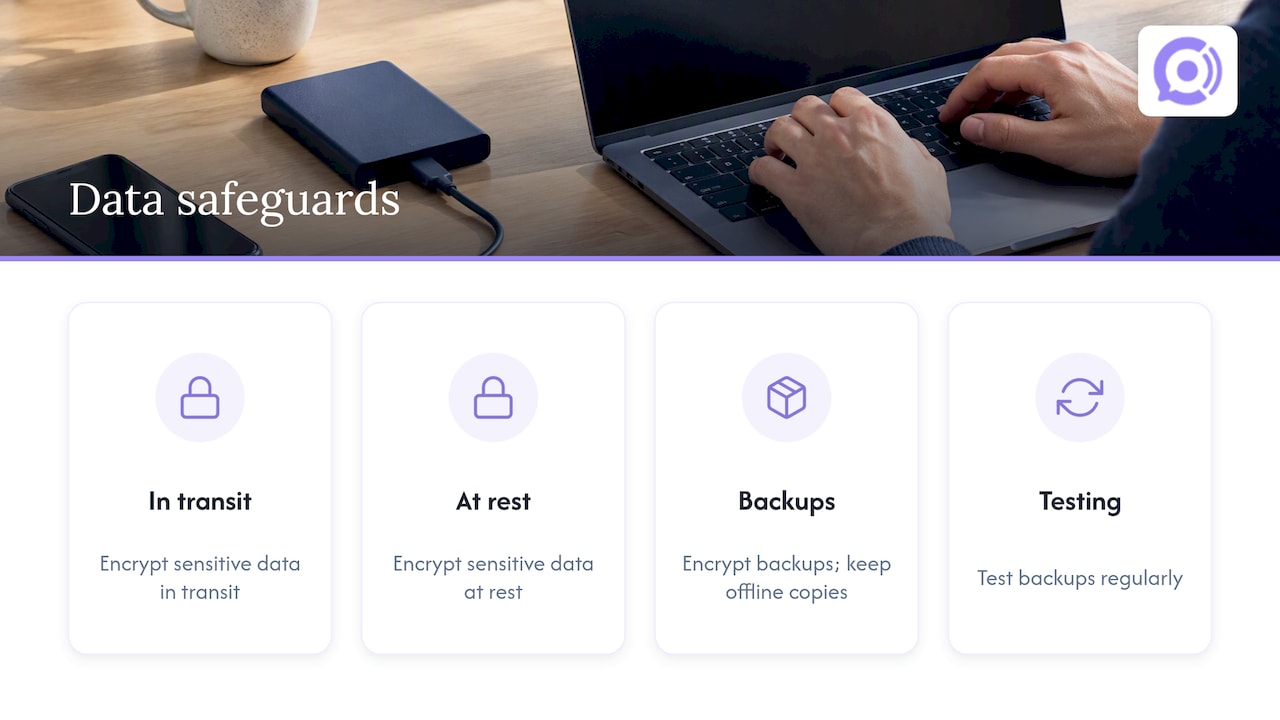
The federal baseline is simple to state. CISA recommends encrypting sensitive business data at rest and in transit, encrypting backups, keeping offline encrypted backups, and testing those backups regularly.
In transit
Recordings move several times: from the phone system to storage, from storage to a reviewer’s browser, and sometimes to an analytics or transcription tool. Each hop is a place where data can be intercepted. CISA and NSA guidance for cloud infrastructure says that systems transmitting data should use TLS 1.2 or higher where applicable, authenticate both ends before sending encrypted data, and rely on managed key and certificate systems.
In practice, ask your provider:
- Is every connection that carries audio or transcripts encrypted, including downloads and API exports?
- Which TLS version is the minimum?
- Are recordings ever emailed as attachments? If so, stop that habit. Share a link that requires a login instead.
At rest
At rest means the file sitting in storage. The same CISA and NSA guidance says primary, replica and backup storage should all be encrypted. The backup part is the one people forget. An encrypted production bucket and an unencrypted weekly export defeat each other.
Also look at the places recordings leak to without anyone planning it: a manager’s downloaded folder, a shared drive, a laptop. The FTC’s business guide advises you to identify where sensitive information is stored, including computers, service-provider systems, digital copiers and wireless devices, before you design protections. Map your recordings first. You cannot encrypt what you did not know existed.
CISA also recommends encrypting laptops, hard drives and removable media, which covers the copy a team lead saves locally to review a tough call.
Treat the keys as seriously as the files
Encryption is only as strong as the handling of its keys. A recording encrypted with a key stored in the same folder is closed with the key taped to the door.
The CISA and NSA guidance points to a few habits worth copying at any size:
- Use managed key systems rather than ad hoc handling, such as a key pasted into a shared document.
- Refresh keys periodically. The guidance describes once-a-year refresh as a good practice.
- Store keys in multiple safe locations, so losing one place does not mean losing every recording permanently.
All of this is in the same CISA and NSA publication. It is written for large cloud infrastructure, so a small store will not run its own key servers. The takeaway for a small store is what to ask the vendor: who holds the keys, how they are rotated, and whether a single employee account can reach both keys and files.
Some platforms let you encrypt each recording with your own public key so that even the provider cannot play it back. That gives you more control but also more responsibility: lose the private key and the recordings are gone. Decide deliberately which model fits a team with no dedicated security staff.
Control who can listen
Most recording exposures are not hackers breaking encryption. They are a former contractor who still has a login, or twenty staff members with playback access when three need it.
The FTC’s 2025 privacy assessment of a claims contractor offers a useful template. It describes recorded live-agent calls as protected by need-to-know authorized access, data minimization, encryption at rest and encrypted transmission of claimant data. A government document for a different industry, but the pattern transfers directly to a support team.
A workable access setup for a small store:
- Roles, not shared logins. Every reviewer has a named account.
- Least privilege. Agents hear their own calls at most. Managers and QA hear a sample. Only an owner or admin can export or delete.
- Internal-only sharing. The FTC’s assessment of a government video-meeting service notes that cloud recordings can be restricted to internal sharing and that access is limited through administrator controls. Look for the same switches in your tool.
- Offboarding. Remove access the day someone leaves.
- An access log you can actually read when something looks off.
If your team reviews calls for quality, our guide to building a compliance plan for support call recording walks through the surrounding process, and our piece on what phone identity checks prove and where they stop covers a related risk: callers proving who they are.
Sensitive data inside e-commerce recordings
Store support calls are not neutral. Callers read out order numbers, shipping addresses, emails, partial card details and sometimes health information (think supplements or medical supplies). Three practical rules:
- Collect less on the call. If an agent, human or AI, can look up an order by order number and email, nobody needs to read a full card number aloud. The less that is said, the less is recorded.
- Keep payments out of the recording. If your calls ever involve card numbers, talk to your payment processor about how to take payment without capturing the digits, and about what card-industry rules mean for your recordings. Do that before you turn recording on, not after.
- Know your regulated data. If any calls involve electronic protected health information, HIPAA applies. HHS’s Security Rule summary says covered entities and business associates must protect the confidentiality, integrity and availability of that data, use reasonable and appropriate safeguards including access controls, and have a compliant business associate agreement before a business associate handles it. If that describes you, involve a privacy attorney or HIPAA compliance professional rather than relying on a vendor’s marketing page.
Retention: keep recordings only as long as you need them
An encrypted archive that never shrinks is still a growing liability. The FTC advises keeping sensitive information only as long as necessary and writing a retention policy that states what you keep, how long, and how it is disposed of securely.
The FTC does not set a number of days for support recordings, and neither should this article. The right period depends on why you record. A simple way to decide:
| Reason you record | Question to ask | Typical approach |
|---|---|---|
| Coaching and quality review | How soon is a call reviewed? | Short window, then delete |
| Dispute or chargeback evidence | How long can a customer dispute an order? | Keep as long as that window, check with your processor |
| Legal or regulatory duty | Does a specific rule require retention? | Follow that rule, confirmed by counsel |
| Training an internal knowledge base | Do you need audio, or only the lessons? | Keep the notes, delete the audio |
Then write it down in one page:
- What gets recorded and why
- How long each type is kept
- Who can access it
- How deletion happens (automatic expiry beats a manual cleanup nobody does)
- What happens to backups, which should expire on the same schedule
Deletion must reach every copy: primary storage, replicas, exports and backups. Test it by picking a call that should have expired and trying to find it.
Consent and the law
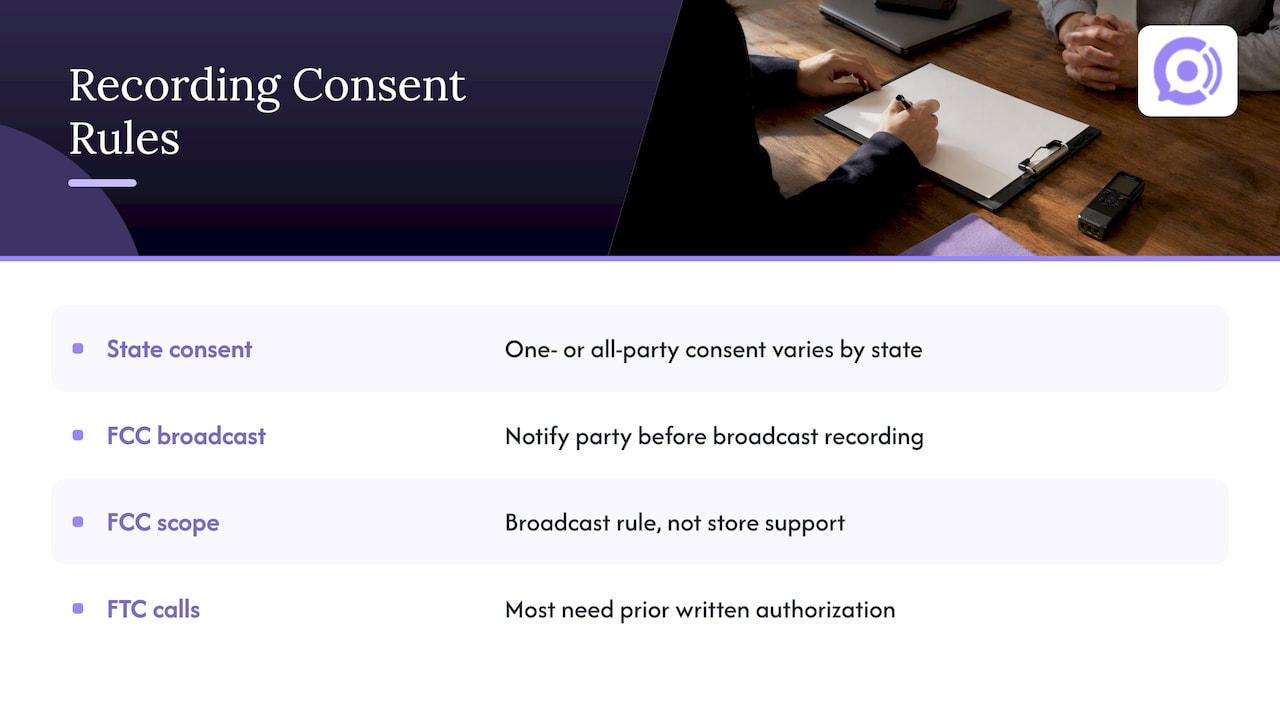
Encryption does nothing about consent. Before you record, callers should know. The U.S. has no single rule for ordinary support calls: states differ on whether one party or all parties must agree, so the safe habit is to announce recording at the start of every call and to confirm requirements with a lawyer for the states where your customers live.
For a sense of how regulators think about this, the FCC’s broadcast rule requires a licensee to inform a party before recording a call for broadcast, unless awareness can be presumed. The FCC treats callers as having a legitimate expectation of privacy, and in a 2007 enforcement order it proposed an $8,000 forfeiture for recording and later broadcasting a call without notice. That rule covers broadcasting, not store support, but the principle of telling people first is the same.
One more distinction. Rules on prerecorded calls are about outbound telemarketing, not recording a customer who calls you. The FTC says most prerecorded telemarketing calls are prohibited without the consumer’s prior written authorization. If your store ever uses automated outbound calls for marketing, that is a separate legal question to take to counsel. The FCC’s 2012 rulemaking spells out what valid written consent for those calls must contain.
Does encryption make you compliant?
No. Encryption supports compliance; it does not establish it. Federal sources frame it that way:
- HHS takes a risk-based approach: reasonable and appropriate administrative, physical and technical safeguards, aimed at confidentiality, integrity, availability, anticipated threats and impermissible disclosures. HHS also says regulated entities must guard against workforce noncompliance, which no cipher fixes.
- CISA calls encryption a critical defense, and pairs it with encrypted backups, regular backup testing and cybersecurity training.
A recording can be perfectly encrypted and still be non-compliant if callers were not told, if forty people can play it, or if it was kept for six years with no reason.
A checklist for evaluating any recording setup
| Area | What good looks like |
|---|---|
| Transit | TLS 1.2 or higher on every connection that carries audio or transcripts |
| At rest | Primary, replica and backup storage all encrypted |
| Keys | Managed system, periodic rotation, stored in more than one safe place |
| Access | Named accounts, least privilege, internal-only sharing, access logs |
| Retention | Written policy, automatic expiry, backups included |
| Consent | Recording announced at the start of each call |
| Sensitive data | Payment and health details minimized or kept out of recordings |
| Testing | Backups and deletion tested on a schedule |
Our view: record less, protect it better
We build AI voice agents for WooCommerce stores, so we think about recordings every day. Our view is that the safest recording is the one you never had to make a human listen to. When a voice agent looks up an order in real time and answers status and return questions directly, callers have less reason to read sensitive details aloud, and your team has fewer calls to dig through.
Orphora AI agents come with call recording and transcripts, call analytics and usage analytics, so you can review what the agent said without sitting through every call. Guardrail workflows around order actions keep the agent inside the steps you define, and agent customization and knowledge base integration let you decide what it can and cannot discuss.
Our advice is to treat the recording policy as part of setup, not an afterthought: decide what you keep, who reviews it, and when it expires before the first customer calls in.
Orphora AI
Put it into practice with a voice agent built for WooCommerce
If phone support is eating your team’s day, an AI voice agent can answer order status, returns and shipping questions around the clock using live order data from your store. The AI Voice Agent plan is $9.99 per month per agent, plus $0.10 per conversation minute. Larger stores can ask about the Enterprise plan, which has no published price. See the AI Voice Agent for WooCommerce.

Bring your retention and consent decisions to setup, and review recordings and transcripts through the same dashboard where you track call volume.
FAQ
Are encrypted call recordings the same as end-to-end encrypted calls?
Not necessarily. End-to-end encryption protects the conversation while it is live, between the two ends. Encrypted recordings protect the saved file in storage and during transfer. A business needs the second one even if the first is in place, because the archive is what stays around for months.
Is encrypting recordings required by law?
No single U.S. law says “encrypt all support call recordings.” Requirements depend on the data and your industry. If calls include electronic protected health information, HIPAA requires reasonable and appropriate safeguards. Federal guidance for small businesses also recommends encryption broadly. Ask counsel what applies to your store.
How long should I keep recordings?
Only as long as you have a reason. The FTC recommends a written policy covering what you keep, for how long and how you dispose of it. Quality review often needs weeks, not years, while dispute evidence may need longer. Set the shortest period that covers your real purpose.
Who should be able to listen to recordings?
Only people who need them for a defined task, such as a QA lead or the owner. Use named accounts, restrict sharing to internal users, and review the access list whenever someone joins or leaves the team.
Do I have to tell callers I am recording?
Yes, as a safe practice. State rules on consent vary, so announce recording at the start of every call and check the rules for the states where your customers live with a qualified attorney.
Sources
- Encrypt Business Data, CISA
- Security Guidance for 5G Cloud Infrastructures Part III, CISA and NSA
- Protecting Personal Information: A Guide for Business, FTC
- Rust Consulting Claims Management Database Two privacy assessment, FTC
- Zoom for Government privacy assessment, FTC
- Summary of the HIPAA Security Rule, HHS
- FCC Section 73.1206 order, 2002
- FCC enforcement order, 2007
- Robocalls, FTC
- TCPA rulemaking, FCC, 2012