

Service Level for Calls: Formula, 80/20 and Targets
Service level for calls is the share of calls answered within a set time. Learn the formula, what 80/20 and 95% mean, and how to pick a target for your store.


Service level for calls is the percentage of incoming calls answered within a set number of seconds. “80/20” means 80% of calls are picked up within 20 seconds. The number tells you how reachable your phone line is, and it is the figure most call center targets are built around. This guide covers the formula, how abandoned calls change the result, what 80/20 and 95% really mean, and how to choose a target that fits a small online store instead of copying a big call center’s.
TL;DR
- Service level = calls answered within the threshold ÷ calls offered, written as a pair such as 80/20 (80% within 20 seconds).
- 80/20 is the familiar benchmark, but it is a convention, not a law. The right target depends on your own call volume, caller patience and what a lost customer costs you.
- Report it by half-hour blocks, not monthly averages, or you will miss the hours that actually hurt.
- Track it next to abandonment rate, average speed of answer and resolution, because a high service level can hide bad calls.
- If you run a WooCommerce store, an AI voice agent can take the staffing math out of the equation for routine calls like order status and returns.
Table of Contents
- What service level means for calls
- How to calculate call service level
- What 80/20 and 95% service levels mean
- How to choose a target for your store
- Service level metrics to track alongside it
- How to improve service level without hurting quality
- Our perspective: service level looks different when the first answer is a voice agent
- What it costs to answer every call
- FAQ
- Sources
What service level means for calls
Service level is a performance metric: the percentage of incoming contacts, usually calls, that an agent answers within a predefined time threshold. It is expressed as two numbers, such as 80% of calls answered within 20 seconds.
The first number is the share of callers you want to serve quickly. The second is how quickly. Change either one and you have a different target. 90/30 and 80/20 are not the same promise, even though both sound strict.
Service level matters because it connects two things that are usually discussed separately. ICMI describes it as a planning and operating measure that links the staffing you need to the accessibility callers experience. Pick a tighter target and you need more people on the phones. Staff too thin and the number falls.
Service level is not the same as an SLA
Search results often use “SLA” and “service level” as if they were one thing. They are related but different. Service level is the metric you measure. A service level agreement is a commitment, to a client or to your own leadership, that you will hit a given level of that metric and others. If you run support for your own store, you probably have a target but no formal agreement, and that is fine.
How to calculate call service level
The basic formula is:
Service level (%) = calls answered within the threshold ÷ total calls offered × 100
Here is a hypothetical half hour for a small store’s phone line:
| Item | Count |
|---|---|
| Calls offered | 100 |
| Answered within 20 seconds | 72 |
| Answered after 20 seconds | 18 |
| Abandoned before being answered | 10 |
Service level at a 20-second threshold is 72 ÷ 100 = 72%. That misses an 80/20 target by eight points.
The abandoned call problem
The messy part is what to do with callers who hang up before anyone answers. Teams handle them in three common ways:
- Count them in the denominator as failures. This is the one used above. It is the strictest and the most honest about what callers experienced.
- Leave them out entirely. The same half hour gives 72 ÷ 90 = 80%. The target looks met, yet ten people gave up.
- Exclude only very short abandons, for example callers who hang up within a few seconds, on the theory that they dialed by mistake.
None of these is universally right. What matters is that you pick one, write it down and keep it constant. A service level that changes definition between reports is useless for trend tracking. It also explains why two companies can both claim 80/20 and deliver very different experiences. ICMI warns that benchmarking against competitors is risky for exactly this reason: identical targets can hide very different results.
If your phone system reports service level for you, check its settings. Most let you set the threshold in seconds and decide how abandons are treated.
What 80/20 and 95% service levels mean
80/20 is the most common benchmark. It says four out of five callers should reach a person within 20 seconds. Competing guides repeat it as the industry standard, and the research backs the point that it remains the most common benchmark, though many organizations are shifting toward measures like average speed of answer or percentage of calls answered.
A 95% service level only makes sense with its threshold attached. “95/30” means 95% of calls answered within 30 seconds. “95/10” is far harder. Read the second number first. A 95% figure with a 60-second threshold can be easier to hit than 80/20.
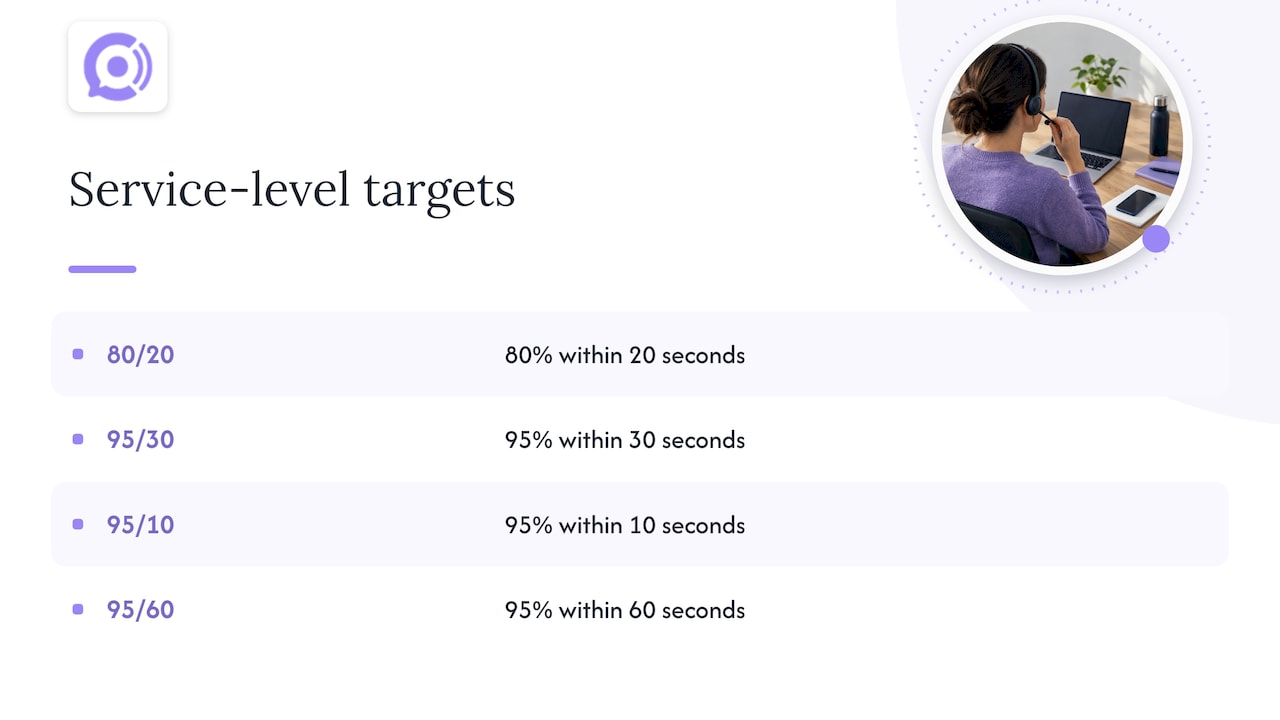
The cost of a tighter target is not linear. Going from 80% to 95% within the same threshold usually means keeping agents idle more of the time, because you must be ready for random bursts of calls. That is why a target should be a business decision and not a bragging number.
Why 80/20 is so popular
Industry commentary on target selection notes that 80/20 is often used because it is familiar, not because it is optimal for a given business’s customer value, cost and patience. McKinsey makes a similar point about contact centers: leaders who imitate others without analyzing their own data are making assumptions about what others are doing.
How to choose a target for your store
ICMI’s position is that no single service level fits every situation. The right target balances customer needs, abandonment, agent well-being and business expense. A practical way to do that:
- Measure your baseline. Pull a few weeks of call logs: calls offered, answered, abandoned and time to answer.
- Find your busy windows. Most stores have clear peaks, such as lunch breaks, evenings and the days after a promotion email or a shipping delay.
- Estimate what a missed call costs. Use your average order value and how often callers are about to buy or to return an item. Target selection works by weighing staffing costs against customer-loss costs, using your own demand, patience, revenue and lifetime value data.
- Set different targets for different lines. A pre-purchase sales line deserves a tighter threshold than a line for “where is my package?”
- Review monthly. Volume changes with seasons and catalog size, so the target should too.
A store taking 15 calls a day does not need the same service level as a 200-seat call center. For a small team, the practical question is simpler: what happens to a call at 7 p.m. or on a Saturday?
Service level metrics to track alongside it
Service level on its own can mislead. Track these with it.
| Metric | What it tells you | Watch out for |
|---|---|---|
| Abandonment rate | Share of callers who hang up before an answer | Rises first when service level slips |
| Average speed of answer (ASA) | Mean wait before pickup | Skewed by a few very long waits |
| First contact resolution | Whether the call solved the problem | A fast answer is worthless if the caller must call back |
| Average handle time | Length of calls and after-call work | Pushing it down can hurt resolution |
| Customer satisfaction | How callers rated the experience | Needs enough survey responses |
ICMI’s white paper explains why ASA is a weaker indicator: it is skewed by callers answered quickly and those who wait much longer, so it is less stable than service level. Still, the two are useful together. Our guide to average speed of answer walks through the formula and benchmarks.
Report by half hour, not by month
The same white paper recommends reporting service level in short intervals such as half-hour blocks rather than daily or monthly averages, so recurring problem periods show up. A 90% monthly average can sit on top of a 40% service level every weekday at noon. Callers don’t experience averages. They experience the minute they call.
Pair speed with quality
Fast pickup is only the entry ticket. If calls are answered in five seconds but handled badly, the metric looks fine and customers still leave. Reviewing a sample of calls closes that gap. See how call quality monitoring can be triaged with AI so a small team isn’t listening to everything.
How to improve service level without hurting quality
There are only a few levers, and each has a trade-off.
- Staff to the forecast, not the average. Schedule by half-hour demand. Add coverage at known peaks instead of adding people all day.
- Cut avoidable calls. Proactive shipping updates, clear return policies and an order tracking page remove calls that never needed a person. Our piece on omnichannel support for ecommerce shows how order context reduces repeat contacts.
- Route by issue. Some questions belong in chat, some on the phone. We cover that in chat vs phone support.
- Use the right tools. Modern call center software with routing, business hours and reporting gives you the data to see where waits pile up.
- Automate routine calls. Order status, return eligibility and shipping questions follow patterns and can be handled without a human. For a broader look at the idea, there is a good overview of customer service automation for DTC brands, and our own take on how to scale support without scaling headcount.
What not to do: chase the number by rushing callers off the phone, or by letting calls ring out and drop. Both improve a report while hurting customers.
Our perspective: service level looks different when the first answer is a voice agent
We built Orphora AI for WooCommerce stores, and we see the same pattern in small-store support. Service level targets were designed for queues of human agents. A store owner who is also the support team doesn’t have a queue, they have a missed call at 8 p.m. and a customer who buys elsewhere.
When the first answer comes from an AI voice agent connected to your order data, the question changes. Instead of “how many agents do I need to answer 80% in 20 seconds?”, you ask “which calls can be fully resolved without a person, and which need a handoff?” The agent looks up the order in real time, answers the status or return question, and follows guardrail workflows for order actions. Because it answers with natural voice conversation and no speech-to-text lag, the wait the caller feels is short.
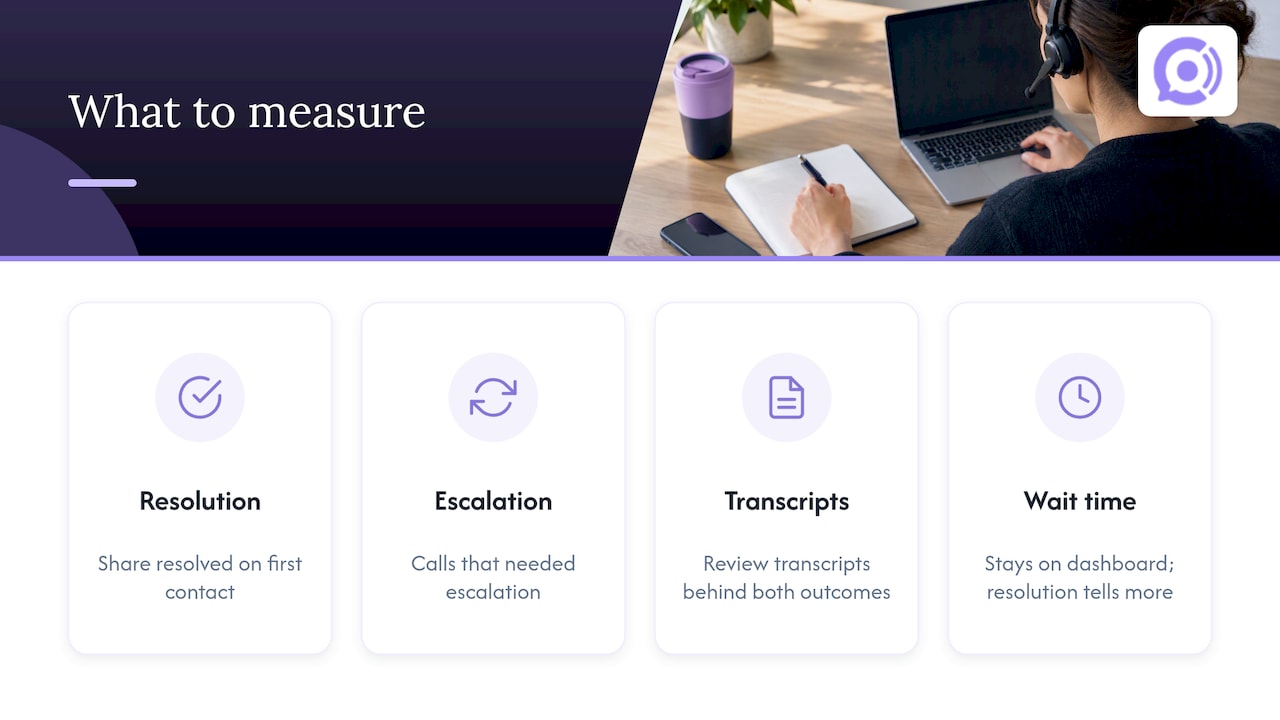
So we would still measure, but we would shift what we watch: the share of calls resolved on the first contact, the calls that needed escalation, and the transcripts behind both. Wait time stays on the dashboard, yet resolution tells you more once nobody is stuck in a queue.
We also think small stores should be wary of borrowing a large call center’s target. Pick the number your customers and your margins justify, and measure it by the half hour.
— Orphora AI
What it costs to answer every call
If your service level problem is mostly routine questions outside business hours, an AI voice agent is a direct fix. Orphora AI’s AI Voice Agent is $9.99 per month per agent, plus $0.10 per conversation minute, so cost follows call volume. It connects to WooCommerce for order lookups, returns and shipping help, and gives you call recordings, transcripts and usage analytics to review. Enterprise is available with no published price. See the AI Voice Agent plans or the feature overview.

To estimate payback for your own store, our AI voice ROI guide uses seven inputs you probably already have. If you record calls, read our call recording compliance plan first.
FAQ
What is service level support?
It usually means the support commitments a team makes about speed and quality, with call answer service level as the most common one. It measures how fast people reach someone, expressed as a percentage within a time threshold. Many teams add targets for resolution and satisfaction.
What does a 95% service level mean?
It means 95% of calls are answered within the stated threshold, and the threshold matters as much as the percentage. A 95/30 target allows 30 seconds, while 95/10 is much harder. Without the second number, a 95% figure tells you little.
What is the 80/20 rule in call centers?
It is the widely used target of answering 80% of calls within 20 seconds. It became common because it is familiar and easy to compare, not because it fits every business. Small stores can reasonably set a different threshold based on their own data.
Do abandoned calls count in service level?
It depends on the formula your team or phone system uses. Counting them in total calls offered is the strictest approach, while excluding them makes the percentage look better. Choose one method, document it and keep it consistent.
How often should I review my service level?
Review it by half-hour blocks every week or month so you can see recurring weak spots. Look at it again whenever call volume changes, such as after a sale or a catalog expansion.
Sources
- What is call center Service Level? Definition, formula and more (Klipfolio)
- Set Service Level with Call Center Cost and the Customer in Mind (ICMI)
- Call center metrics and KPIs white paper (ICMI)
- Beyond the Benchmark (The Forum, 2025)
- Service Level Target Selection (WFM Labs)
- Myth busters: unexpected insights on contact centers (McKinsey)
- How call center software is revolutionizing the customer experience
- Customer service automation for DTC