

SMS vs Voice Support: Which Channel Fits Your Store?
SMS or voice for customer support? Compare speed, cost, compliance and customer preference, and learn how WooCommerce stores can route each issue to the right channel.


Use SMS for short, low-stakes, asynchronous exchanges: shipping updates, delivery confirmations, quick yes/no answers. Use voice for anything urgent, emotional or multi-step: a missing order, a return that went wrong, a billing question. Most online stores need both, and the real decision is which issues go where. This guide compares the two channels on speed, cost, customer preference and legal risk, then gives you a routing rule you can apply this week.
TL;DR
- SMS wins on scale and convenience for updates and simple questions. Voice wins when the customer is stressed, the issue has several parts, or a human-sounding answer matters.
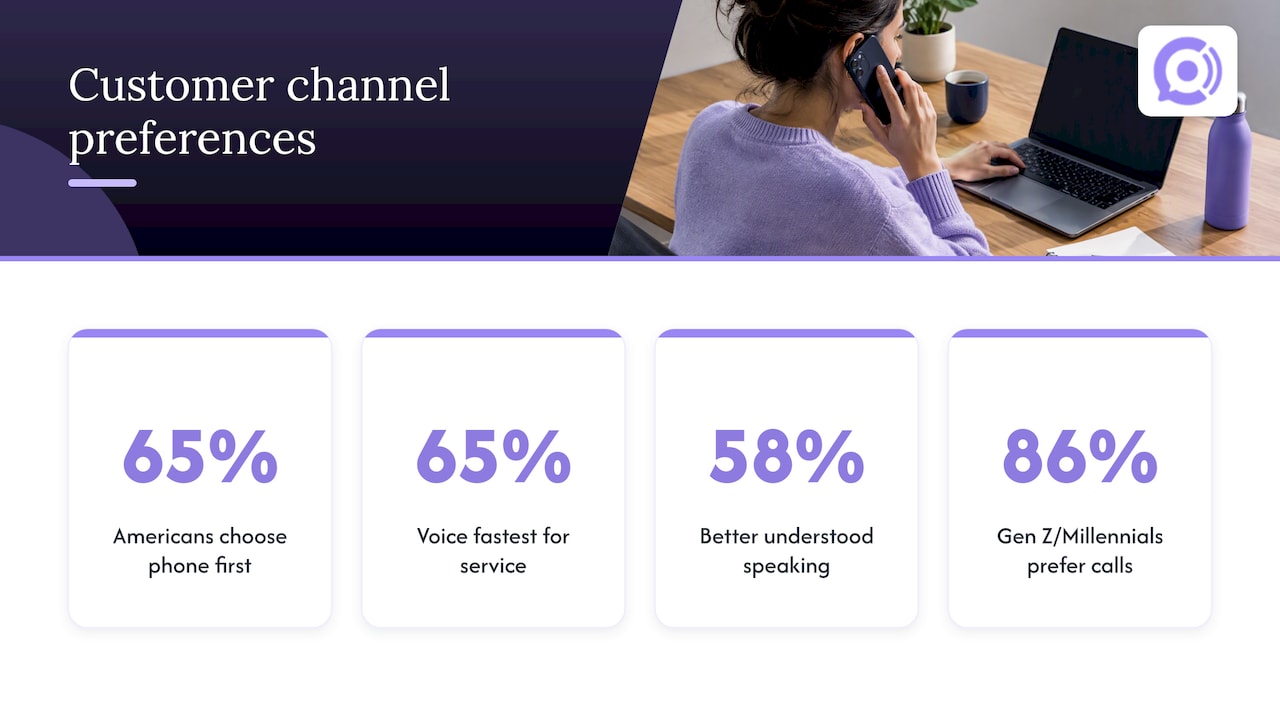
- In a 2025 PolyAI study, 65% of Americans preferred a phone call as their primary way to contact customer service. Phone is not a legacy channel.
- Both channels fall under the Telephone Consumer Protection Act (TCPA), and the consent rules differ by message type.
- Route by issue type, not by what is cheapest for your team. AI voice agents now remove most of the staffing cost that used to make phone support the expensive option.
Table of Contents
- What each channel actually does well
- What customers say they prefer
- Speed and cost: where the old math breaks
- When SMS is the better support channel
- When voice is the better support channel
- A routing rule you can use today
- The compliance question for both channels
- Our perspective
- Adding voice support without hiring
- FAQ
- Sources
What each channel actually does well
The two channels are often compared as if they were rivals for the same job. They are not.
SMS support means answering questions and resolving issues by text message from a business number. It is asynchronous: the customer sends a message, goes back to their day, and reads your reply later. One agent can juggle several threads at once, and the customer keeps a written record.
Voice support means a live, synchronous conversation. The customer says the problem in their own words, hears a reply immediately, and can correct a misunderstanding in seconds instead of three message rounds.
That difference in rhythm drives everything else.
| Factor | SMS | Voice |
|---|---|---|
| Rhythm | Asynchronous, customer can walk away | Real time, both sides present |
| Best for | Order updates, confirmations, simple FAQs, links | Order problems, returns, complaints, anything with follow-up questions |
| Staffing (human) | One agent can handle several threads | One call at a time |
| Customer record | Written thread | Recording or transcript, if you enable it |
| Emotional tone | Easy to misread | Tone and urgency come through |
| Complexity ceiling | Low to medium | Medium to high |
| Consent rules | TCPA, strict for marketing texts | TCPA, strict for autodialed or prerecorded outreach |
What customers say they prefer
It is tempting to assume everyone under 40 wants to text. The data does not back that up.
In the PolyAI consumer study, 65% of Americans chose a phone call as their primary way of contacting retail brands, and the same share believed voice is the fastest way to resolve a service issue. The study also reported that 58% feel better understood when they speak rather than type. Its figures for younger shoppers cut against the common assumption: 86% of Gen Z and Millennials said they prefer calling for customer service.
A caveat: PolyAI sells voice AI, so read the study as one informed data point rather than a neutral census. The independent picture from YouGov points the same direction on one important detail. Nearly 70% of Americans tend to use phone support, yet only 35% prefer it in that survey’s framing of the usage-versus-preference gap. The lesson is that what customers use reflects what you make available, not necessarily what they would choose. If your site hides a phone number and offers only a chat widget and a text line, your channel mix tells you about your design, not about your customers.
One more finding worth knowing. In a 2025 CX report, chatbots and FAQ or self-help tools had a perception score of -30%, while phone and live agent chat ranked among the best-rated channels. Customers do not hate automation. They hate automation that traps them. That is why the quality of what answers the phone matters more than whether it is a person or software.
Speed and cost: where the old math breaks
The traditional argument for SMS is cost. A human on a phone call handles one customer at a time, so phone support scaled with headcount. Texting let one person run several conversations, so it looked cheaper per ticket. For a small store, that was often the whole reason to push customers toward text and email.
That math changes when the person answering the phone is an AI voice agent. There is no queue, no hold music and no after-hours voicemail, and the agent can look up an order while the customer is still talking. The constraint becomes usage cost rather than staffing cost.
Here is what that looks like with our own pricing, so you can check the numbers against your volume. An AI Voice Agent from Orphora AI is $9.99 per month per agent, plus $0.10 per conversation minute. Take a store that gets 300 calls a month averaging 3 minutes:
- Call usage: 300 calls × 3 minutes × $0.10 = $90.00
- One agent: $9.99
- Total: $99.99 per month
That is an illustration of the arithmetic, not a forecast of your bill. Your call length and volume will differ, and an Enterprise plan exists for larger needs, with no published price. If you want to model payback against your own ticket costs, our walkthrough on calculating WooCommerce payback with seven inputs covers it.
SMS has its own costs that are easy to overlook: carrier registration, per-message fees, and the human time to answer. A text thread that drags on for fifteen back-and-forth messages about a lost parcel can cost more of an agent’s time than a three-minute call would.
When SMS is the better support channel
Choose text when the customer’s need is small and the answer is short.
- Proactive order updates. Shipped, out for delivery, delivered. A text with a tracking link answers the question before the customer asks it.
- Simple confirmations. Address verified, return label sent, refund issued.
- Links and codes. A customer asking for a size chart, a return portal or a reset link is better served by a tappable message than by a spoken URL.
- Low-urgency questions. “Do you restock this in blue?” does not need a call.
- Customers who cannot talk. Someone on a train or at work may truly prefer to type.
SMS also works well as the follow-up to a voice call: the agent resolves the issue, then a text confirms what was decided and includes the relevant link.
When voice is the better support channel
Choose voice when the cost of misunderstanding is high.
- Where is my order. These calls are frequent and anxious. The customer wants a firm answer now. Our guide on order tracking automation to stop WISMO calls goes into how to handle them.
- Returns and exchanges. They involve conditions (window, condition of item, refund versus store credit) that customers want to talk through.
- Damaged or wrong items. The customer is annoyed, and tone matters.
- Multi-part problems. “I changed my address, but also the coupon didn’t apply, and I need it by Friday” is a nightmare in text and a ninety-second call.
- Customers who just prefer to call. Many do, and they will not be talked out of it.
The PolyAI study also found that 71% of consumers are receptive to AI voice assistants when they can do specific tasks such as real-time order lookups and returns, without the lag of button-press menus. The condition is the important part: the assistant must be able to actually do something. A voice bot that can only read FAQ pages and then transfers you is the experience that earns the negative scores above.
If you are curious how conversational AI that handles real tasks is packaged as a product, this marketplace listing for an AI support agent business gives a concrete example of how such agents are positioned.
A routing rule you can use today
Rather than picking one channel, assign issues. Here is a simple starting point for a WooCommerce store.
- List your top ten contact reasons. Pull them from your inbox, helpdesk or call log from the last 60 days.
- Score each on two questions. Does the customer need an answer in under a few minutes? Does resolving it need more than one exchange of information?
- Assign the channel. Yes to either question: voice. No to both: SMS or email.
- Add a handoff. Any channel should be able to move to another, and to a human, without making the customer repeat themselves. See our rules for AI-to-human escalation.
- Review monthly. Look at which issues bounce between channels. Those are misrouted.
We go deeper on the same principle in Chat vs Phone Support: Route by Issue, Not Staffing Cost, and our piece on four WooCommerce phone paths to test compares options from push alerts to voice.
The compliance question for both channels
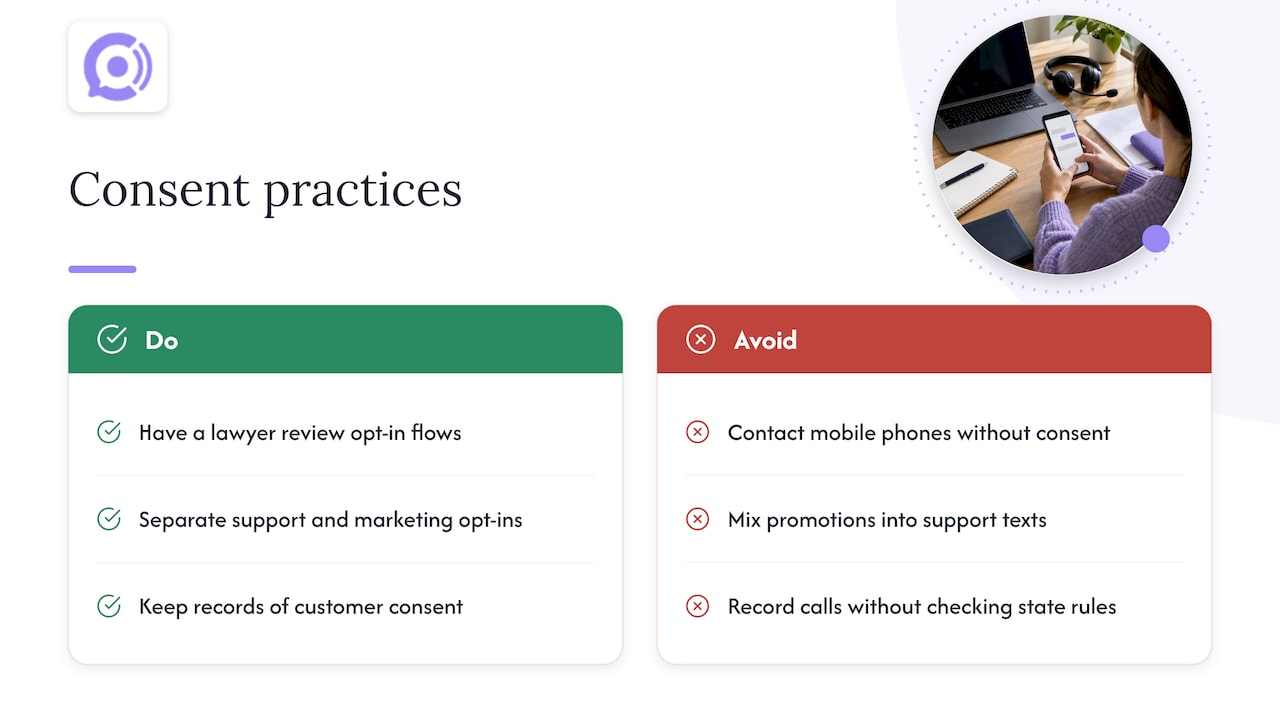
Both SMS and voice sit under the Telephone Consumer Protection Act. This is not legal advice, so have a lawyer review your opt-in flows before you send anything at scale. Here is what the sources say.
The FCC explains that businesses using autodialers or artificial or prerecorded voice messages need prior express consent before contacting mobile phones. The statute itself, 47 U.S.C. § 227, makes it unlawful to use an automatic telephone dialing system or an artificial or prerecorded voice to call without that consent, outside emergency calls.
The practical gap many store owners miss is the difference between message types. An informational text, such as a reply to a customer who just asked about their order, is treated differently from a commercial marketing text, which needs prior express written consent. If your support texts start carrying promotions, you may have crossed that line. Keep support messages and marketing messages in separate opt-in flows, and keep records of when and how each customer agreed.
Voice has its own consideration. An inbound call, where the customer dials you, is a different situation from outbound calling. Recording calls adds another layer: consent rules for recording vary by state, which is why we wrote a six-step compliance plan for support call recording.
Our perspective
We built Orphora AI because we kept seeing the same pattern in WooCommerce stores: owners pushed customers toward text and email because phone support meant hiring, then wondered why complaint threads grew long and frustrated. The channel was chosen for the store’s convenience, not the customer’s.
Our view is that voice should be the default for urgent, order-specific problems, and that software can now do the staffing job. An agent that can read real-time order and customer data from WooCommerce can answer “where is my order” and walk through a return on the first call, at any hour. We pair that with guardrail workflows for order actions, so the agent does what you have approved and nothing more.
We do not think SMS is outdated. It is a good tool for notifications and links. We think it is a poor tool for resolving a problem that has three moving parts. So we would use both: voice for the conversation, text for the confirmation.
And we would test before trusting. Run real orders, returns and discount codes through any voice setup, our own included. Our voice AI accuracy testing guide shows how, and the eight-check launch list for WooCommerce voice bots covers the rest.
— Orphora AI
Adding voice support without hiring
If your store runs on WooCommerce and you want phone support that is available around the clock, Orphora AI voice agents connect to your store, look up orders in real time, and handle order status, returns and shipping questions by phone. You get call recording and transcripts, call analytics, agent customization and knowledge base integration. Pricing is $9.99 per month per agent plus $0.10 per conversation minute, so you pay for the calls that actually happen.
Two setup tips from our side. Keep the knowledge base tight to avoid delays: see why we suggest staying under 200 FAQs. And confirm your shipping policy is clear enough to automate before calls go live.
FAQ
Is SMS outdated for customer support?
No. SMS is still effective for short updates, confirmations and links. It is weaker for complex problems, where several message rounds slow resolution and tone gets lost. Treat it as a complement to voice, not a replacement.
Do customers really prefer phone over text?
It depends on the issue and the survey, but the recent evidence is strong for phone. In PolyAI’s 2025 study, 65% of Americans preferred a phone call as their primary contact method with retail brands. Because that company sells voice AI, check the pattern against your own contact data.
Do I need consent to text customers about their orders?
Yes, you should have a documented opt-in, and the type of message matters. Informational texts and marketing texts are treated differently under the TCPA, and marketing texts need prior express written consent, per FCC guidance. Ask a telecom or privacy attorney to review your opt-in wording.
Can an AI voice agent replace SMS support?
It can replace much of the problem-solving that SMS threads handle poorly, such as order status and returns. SMS still earns its place for confirmations and links sent after the call. Most stores do best with voice for the conversation and text for the follow-up.
Sources
- Hear Me Out: Consumer Study Reveals Phone Still Reigns in Customer Service (PolyAI, PR Newswire)
- How Americans prefer to contact businesses for customer service (YouGov)
- 2025 CX Leaders Consumer Edition research report (Execs In The Know)
- Stop Unwanted Robocalls and Texts (FCC)
- 47 U.S.C. § 227: Restrictions on use of telephone equipment