
After-Hours Support for WooCommerce Stores: A Practical Guide
How to cover nights, weekends and holidays in a WooCommerce store: options compared, costs, compliance rules and a setup checklist for phone support.


After-hours support means a customer gets a real answer when your team is offline: nights, weekends and holidays. For a small WooCommerce store, you have four workable options: an answering service, a contracted overflow call center, self-service plus email, or an AI voice agent connected to your order data. The right one depends on what people call about, how many calls arrive outside business hours, and how much of each call is a lookup rather than a judgment.
This guide walks through each option with honest trade-offs, the numbers that matter, the US rules you need to know before you answer calls with AI, and a checklist for launching.
TL;DR
- Most after-hours calls to online stores are lookups (where is my order, how do I return this). Those are the calls to automate first.
- An answering service takes messages. A live overflow center follows scripts. An AI voice agent with order access can actually resolve the call.
- Customers want 24/7 availability but still want a human reachable for hard problems, so build an escalation path instead of a wall.
- In the US, inbound AI calls raise recording-consent and disclosure questions. Settle them before launch, not after.
- With Orphora AI, an agent costs 9.99 USD per month plus 0.10 USD per conversation minute, so after-hours coverage scales with call volume rather than headcount.
Table of Contents
- What after-hours support actually has to cover
- Four ways to cover nights and weekends
- What customers expect after hours
- Phone or chat after hours?
- How AI voice support works for a WooCommerce store
- What after-hours coverage costs
- US rules to settle before you answer calls with AI
- Our perspective: automate the lookup, protect the judgment
- A launch checklist for after-hours phone support
- Where Orphora AI fits
- FAQ
- Sources
What after-hours support actually has to cover
Before choosing a tool, sort the calls you miss. Pull a week of voicemails, missed-call logs and email subjects that begin with “I tried calling.” Most WooCommerce stores find the same pattern:
- Order status and delivery questions. The largest group by far. The answer sits in the order record.
- Returns and exchanges. Policy plus an order lookup. Often fully answerable without a person.
- Order changes. Address fixes, cancellations before shipping. Time-sensitive, and they need guardrails.
- Pre-sale questions. Sizing, compatibility, shipping cost. Answerable from a good knowledge base.
- Real problems. Damaged goods, billing disputes, angry customers. These need a human, and the best after-hours setup says so quickly and hands over cleanly.
If 70 percent of your missed calls fall in the first three groups, you do not have a staffing problem. You have a lookup problem, and that changes which solution makes sense.
Four ways to cover nights and weekends
| Option | What the caller gets | Typical weakness | Best fit |
|---|---|---|---|
| Voicemail plus email follow-up | A recorded greeting, a reply next business day | Many callers hang up without leaving a message | Very low call volume |
| Live answering service | A person who takes a message or follows a short script | Cannot see your orders, so most calls end in a callback | Businesses where calls are leads or urgent dispatches |
| Overflow or after-hours call center | A trained agent working from your scripts | Per-call or per-minute fees, training time, limited store access | Higher volume with complex, scripted calls |
| AI voice agent connected to your store | An immediate answer using live order data | Needs setup, a clean knowledge base, and a human fallback | Stores where most calls are lookups and policy questions |
Search results for this topic are dominated by IT help desks and call-center vendors. That makes sense for their audience, because an overnight server outage needs an on-call engineer. An online store is different. The person calling at 9 p.m. rarely needs an engineer. They need to know whether the package ships tomorrow.
Why answering services struggle with ecommerce
An answering service can be friendly and professional and still unable to help, because it cannot see the order. The agent writes down the caller’s name and number, and someone on your team calls back the next morning. You have paid for a handoff, not a resolution. For a lead-based business that is fine. For a store where the caller is already a customer, it often means a second contact attempt, and the customer may have emailed, opened a dispute or cancelled in the meantime.
Where human overflow centers fit
A staffed overflow center is the right call when conversations are long, emotional or need judgment, for example high-ticket items, regulated products or white-glove service. The cost is per minute or per call, and quality depends on how well you train the agents on your products and policies. If you go this route, give them a written escalation guide and a short list of what they may and may not promise.
What customers expect after hours
Customers are not asking for robots. They are asking for answers. The 2025 State of CX report from Hyken found that 55% of US customers rank 24/7 availability as a top expectation, yet 47% still prefer access to live human support when issues arise. Read those two numbers together: the winning design is automation that handles routine contacts instantly and a clear route to a person for the rest.
That is also how we would design any after-hours flow:
- Answer immediately, with no menu maze.
- Resolve what can be resolved from real data.
- When the issue needs a person, capture the details once, tell the caller exactly when someone will respond, and pass the full context along so nobody has to repeat themselves. We cover this in more depth in our guide to AI-to-human escalation.
Phone or chat after hours?
Chat widgets and email autoresponders are cheaper to run, and they suit customers who are already on your site. But a customer with a late delivery is often on their phone, away from a laptop, and picks up the phone because the order confirmation printed a number. Route by issue type, not by what is cheapest for you. Our post on chat versus phone support explains how to decide which channel fits which issue.
A practical split for most WooCommerce stores:
- Chat and email: product questions, documentation, non-urgent requests.
- Phone: delivery problems, order changes, anything where the caller is stressed or in motion.
How AI voice support works for a WooCommerce store
An AI voice agent answers the phone, understands what the caller says, looks up the relevant order, and responds in natural speech. For WooCommerce, the lookup runs through the platform’s own interface. WooCommerce is integrated with the WordPress REST API, which lets order and customer data be read and updated in JSON, and its v3 endpoints are the recommended version for new integrations.
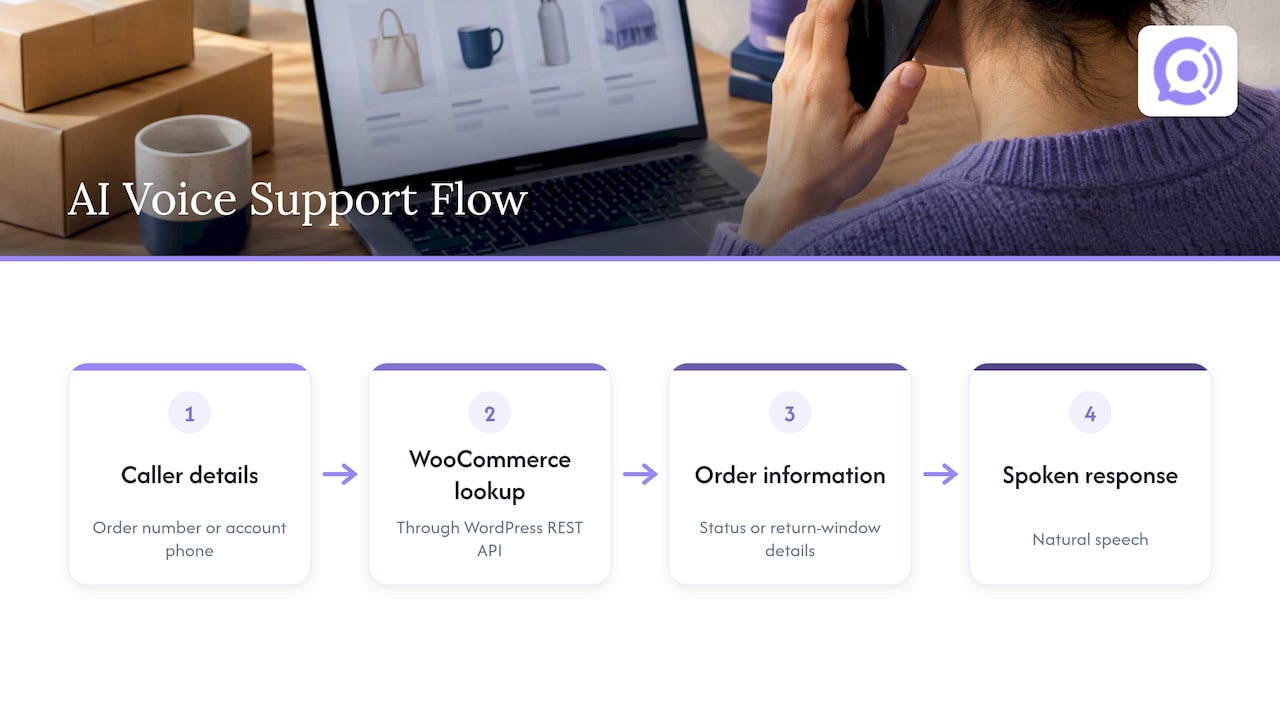
That is the practical difference from an answering service: the agent sees what you see. A caller gives an order number or the phone number on the account, and the agent can say the order shipped yesterday, what the status is, and what your return window is.
This is the design Orphora AI is built around. We make voice agents specifically for WooCommerce stores, with real-time order data access, call recording and transcripts, call analytics, a knowledge base for policies, and agent customization. We also provision US phone numbers, so you are not stitching together a telephony provider yourself. You can see the full list on our features page.
Setup details that trip people up
Two WooCommerce points are worth checking before any voice integration goes live:
- Permalinks. According to the research we reviewed, default WordPress permalinks can make REST API endpoints fail, which breaks live order lookups. Switch to a pretty permalink structure first.
- Keys and limits. Keep API consumer keys secret, give them only the access they need, and plan for rate limits if call volume spikes.
We list more pre-launch checks in WooCommerce voice bot: 8 checks for a safer launch, and compare approaches in 4 WooCommerce phone paths to test.
What after-hours coverage costs
Costs for staffed options vary widely by vendor and contract, so get written quotes and read the minimum-volume terms. For an AI voice agent the math is simple enough to do yourself.
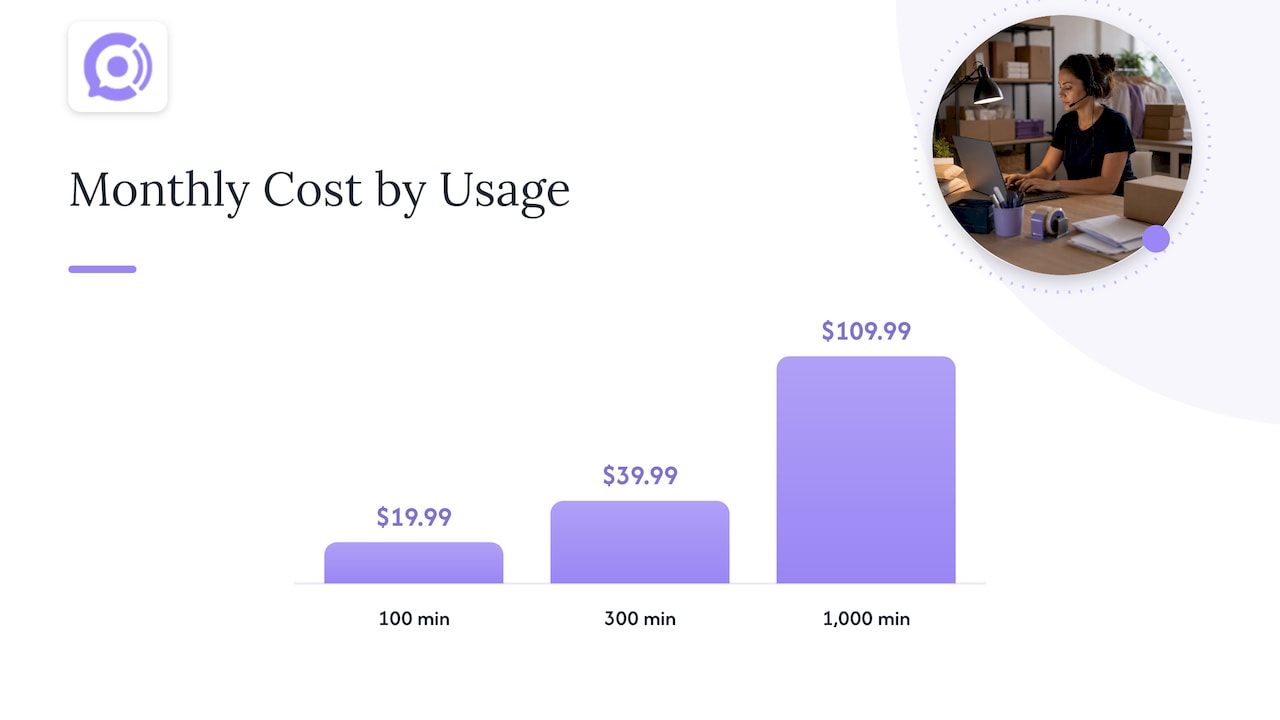
Orphora AI pricing as published: 9.99 USD per month per agent, plus 0.10 USD per conversation minute. There is also an Enterprise plan with no published price.
A worked example, using only those two figures:
| Monthly after-hours minutes | Usage charge at 0.10 USD/min | Plus one agent at 9.99 USD | Monthly total |
|---|---|---|---|
| 100 | 10.00 USD | 9.99 USD | 19.99 USD |
| 300 | 30.00 USD | 9.99 USD | 39.99 USD |
| 1,000 | 100.00 USD | 9.99 USD | 109.99 USD |
The point of usage pricing is that a quiet month costs little and you do not pay for a night shift that sits idle. To compare this against your current costs and missed-call losses, our AI voice ROI guide walks through seven inputs you can fill in from your own data.
US rules to settle before you answer calls with AI
This is general information, not legal advice. If you operate in several states or sell regulated goods, talk to a lawyer who handles telecom and privacy.
Outbound calls and the TCPA
The FCC confirmed in February 2024 that the TCPA’s restrictions on artificial or prerecorded voices cover current AI technologies that generate human voices. Calls using them require the prior express consent of the called party. The full declaratory ruling is public. In plain terms: if your agent calls customers back, for example to follow up on a missed call, you need consent first, and the call must identify your business at the start. Answering a call the customer placed is a different situation, but do not assume the rest is free of rules.
Recording and disclosure on inbound calls
Recording laws differ by state, and some require every party’s consent. A 2025 Goodwin analysis of AI voice products under California privacy law shows why vendors and businesses both pay attention to this. The safe habit is simple: have the agent say at the start of every call that it is an AI assistant and that the call may be recorded, then give the caller an easy way to reach a person. Our 6-step compliance plan for support call recording covers retention, access and disclosure in detail.
Using call data to train models
The FTC has been clear that consent cannot be buried in legalese or hidden checkboxes, and has pushed companies to delete data and models built from information collected without proper consent. If any vendor wants to train on your callers’ voices, ask for the terms in writing. For background on what responsible handling of voice data looks like, this overview of consent and privacy duties for AI voice and video tools is a useful read.
Our perspective: automate the lookup, protect the judgment
We built Orphora AI because the after-hours problem for a small store is lopsided. Almost no one wants to staff a night shift to answer the same order-status question, yet each missed call is a customer deciding whether to wait, email, or walk away.
Here is what we believe, and how it shapes the product:
Speed is part of the answer. A voice agent that pauses awkwardly feels broken. That is why we focus on natural, instant conversation rather than a clunky speech-to-text chain, and why we write about voice bot training data and keeping knowledge bases under 200 FAQs to avoid latency.
Data beats scripts. An agent that can read the order will beat a better-trained agent that cannot. That is the advantage of building for one platform rather than for every industry.
Guardrails matter more than cleverness. Order actions such as cancellations need rules: what the agent may do, what it must confirm, when it hands off. Start with read-only answers, then enable actions one at a time.
Monitoring never ends. Models and policies change. Review transcripts weekly in the first month, then on a schedule. Outside guidance on ongoing oversight of AI and measuring it against business goals points the same way, and so does our post on call quality monitoring with AI triage.
People stay in the loop. We think of AI as the bridge between closing time and opening time, not a replacement for your team.
— Orphora AI
A launch checklist for after-hours phone support
- Measure the gap. Count missed calls by hour for two weeks and tag the reason for each.
- Write the after-hours promise. Decide what you will resolve on the call, what you will route to a person, and the response time you will state for the latter.
- Clean up the knowledge base. Shipping times, return windows, holiday schedules, exceptions. Short, current and unambiguous beats long and exhaustive.
- Prepare WooCommerce. Pretty permalinks on, API keys scoped, a test order set covering shipped, delayed, partially refunded and cancelled states.
- Write the disclosure. AI identification and recording notice in the first seconds of the call.
- Set the escalation path. A named inbox or on-call contact, a promised response window, and a transcript passed along with the case.
- Run a soft launch. Enable only weekend or overnight hours first and read every transcript.
- Review weekly. Look at calls that ended in handoff, repeated questions and hang-ups. Each one is a knowledge base fix.
Where Orphora AI fits
If most of your out-of-hours calls are order status, returns and shipping questions, Orphora AI is designed for exactly that. You get a voice agent connected to your WooCommerce data, call transcripts and analytics, and a US phone number, for 9.99 USD per month per agent plus 0.10 USD per minute of conversation. See the plans and details or the feature overview to decide whether it suits your store.
FAQ
What is an after-hours answering service?
It is a service where trained operators answer your calls when your office is closed, usually taking messages, following a script or forwarding urgent matters. It works well for appointment-based and lead-driven businesses. For online stores it is limited because operators typically cannot see order data.
Can I offer weekend customer support without hiring staff?
Yes, for the routine part of it. Self-service pages, email autoresponders and an AI voice agent connected to your store can handle order status and return questions on weekends. Keep a clear route to a person for complex issues, with a stated response time for Monday.
Do I have to tell callers they are talking to an AI?
We recommend always saying so at the start of the call. For calls your business initiates, the FCC treats AI-generated voices as artificial or prerecorded voices, which brings consent and identification requirements. For inbound calls, recording rules vary by state, so check with counsel.
Will customers accept an AI answering after hours?
Most will accept it when it solves their problem quickly and lets them reach a person when it cannot. Survey data shows customers value 24/7 availability but still want live support available for harder issues, so design for both.
Does after-hours phone support work with WooCommerce?
Yes. WooCommerce exposes orders and customers through its REST API, which allows a voice agent to read live order data during a call. Enable pretty permalinks and secure your API keys before connecting anything.
Sources
- Hyken, State of CX 2025
- WooCommerce REST API documentation
- WooCommerce REST API v3
- FCC: TCPA applies to AI technologies that generate human voices
- FCC 24-17 Declaratory Ruling
- Goodwin: AI voice products and California privacy claims